The Culture, Not the Complexion.

Honey doesn’t come in one shade. It’s pale gold in one jar and near-black in another, and every jar is still, unmistakably, honey. Summer time is coming to an end, and our babies have changed between each shade! It’s wonderful. This is what I want to talk about and help you consider. The color of your childs skin is and is not important to their sense of belonging within the Black community. This can get complicated, so let me give you a brief overview, and leave you with some food for thought.

Blackness, no matter who tells you otherwise, is not dependent on the levels of melanin detected or visible. Blackness is cultural. It is subconscious. It is a spiritual connection. It is a community knowing-ness. This is why you’ll hear people question the validity of Black people raised without Black community, not because their skin is in question, but because access to the culture is. It’s seen as evidence of a severing from the source of our collective strength. Like any cultural or spiritual practice, it is difficult to cultivate in isolation. You need to be taught. You need mentors. You need mirrors to see yourself in dimensions other than your own.

So Black skin has very little to do with whether your child is Black. The issue exists inside a deeply racist society, and that society defines Black very differently. It treats Blackness as a commodified identity, given the value the powers that be decide it deserves. Our society is deeply divided right now about the value of any human life. The value of Black lives is traditionally and historically negotiable and always optionally invalid. So it is essential that, as parents of children society will attempt to devalue, you instill the love and stability of the actual culture of being Black, not the ill-fitted, deranged version society will insist your babies accept.

Community is important. Image and representation are extremely important. Knowledge and foundational emotional support are essential. Self-love can be cultivated anywhere, it just needs more support in places where community is sparse.

One important note: please, please, please do not fall into the idea that Blackness, the culture and connection, looks one way. We are not all churchgoers. We are not all basketball players. We are not all dancers. We are not all socially driven to create change for our people. Don’t take on more than you can chew. Self-love of our skin in all its shades, our hair in all its coil patterns, our lips, our nose goes a long way. The strength found in difference is somewhere every parent could benefit from leaning into: the idea that your child is part of a much bigger picture, a global majority, in fact. That their difference has strength, and is admired and loved by you, and through you.

When someone attempts to measure your child’s Blackness, your child will have enough self-love, respect, and groundedness to know there is no such thing as too Black or not Black enough. Those judgments are projections from people still struggling to hold on to an identity they believe can be compromised. It’s okay. It’s not your child’s battle to fight.

So, for the parents unsure where to start: yes, your children need to experience Black community. Just make sure that exposure is positive and immersive. There are camps, hairdressers, educators to tap into. If they’re not in your city, take the time to find where they are and get involved. At the very least know the basics of our culture as fact, not as a side note to your day. Know the beauty, the growth, the positive contributions of Black people from your own area, they’re there. Know them nationally too. Start there as your reference point, not as a “hey, you should know this,” but as naturally as knowing lemons are tart. It just is what it is. Your confidence and your understanding will let your baby stand fully in their own.

Dripping melanin and honey, in every shade. No apology required.

Two Scoops and a Ponytail: Caring for Black and Brown Babies This Summer

Summertime is here and thriving. It’s hotter than we can ever imagine, and for our brown babies, there’s a lot to consider. The aesthetics of summer are one thing, but the ongoing care of these babies is something deeper, it’s a practice of cultural connection, and getting fluent in it can help parents who are not Black or Brown feel more grounded in raising a child who the world will insist belongs to a community they themselves didn’t grow up in.

I hear a lot from white parents about the experience of “Black Aunties” offering advice, often when the parents feel like they’ve already done everything right. Some welcome it. Some feel confronted by it. Some of you have no Black references outside of YouTube and Facebook groups, and I’m not here to judge either way. As a Black woman, parent, and grandmother who works in growth and development coaching across several sectors, I can tell you the concern comes from love. The Black community doesn’t separate children raised by other communities, biracial or not, from the center of community care. Slavery may not be visible in our society anymore, but the subconscious belief in a right of ownership over Black and Brown bodies still is.

I’ve said this before and I’ll say it again: most of the work I do with biracial Black and white adults who were deeply harmed as children. Ninety-nine percent of them recognize that their first, and ongoing, experiences of racism came from their own family.

That’s not just heartbreaking. It’s complicated, and it goes straight to the core of their ability to build an honest sense of who they are in either community they belong to.

What I’m offering here is a surface-level start. It is an early, practical awareness of how your baby will need to navigate the social ups and downs they’ll inevitably face. This kind of “knowing” is just the beginning of a practice that’s standard in Black and Brown communities. It’s expected the way it’s expected that you’d use a fork to eat noodles. It’s common sense. And it starts somewhere very simple: skin and hair.

I hope most parents have learned by now that lotion by itself isn’t a long-term solution for richly melanated skin, it just doesn’t last. Solution mixes with high levels of shea butter, cocoa butter, and coconut oil are fantastic for baby’s skin, all the way through adulthood. Those oils on their own, whipped, are sometimes even better.

What people usually get wrong isn’t what they buy but it’s how often they apply it. This isn’t a once-after-bath situation, especially in summer, and even more so in winter. You apply it multiple times a day. It should live in your diaper bag, your carry bag, and eventually their locker in middle school and high school. How well you care for your Black and Brown baby’s skin is a real indicator of how well you’re caring for them, period.

This is tradition and connection, not vanity. Beauty is a fortunate bi-product. Beyond leaving their skin bright and shiny, you’re giving your baby a massage and connecting with them multiple times a day. As they get older, they’re connecting with their own body doing it themselves and it genuinely massages the lymph nodes. It’s a healthy practice all around.

It’s summer, so water play is probably on the weekly schedule if not daily, which means oils and lotion mixes are necessary, but let’s talk about hair.

Please, please, please check on the health of their hair. Afro-textured hair needs love almost immediately after water play, to avoid knots and the tears that come with combing them out. A spray bottle with water and a little conditioner mixed in is a great tool to use right after water play ends. Brush through it quickly while it’s still wet, spray it, and pull it into a quick ponytail; your kiddo will feel taken care of, look cute, and feel on top of the world before they pass out in the back seat on the way home. Side note: Wide brushes, wide tooth combs, or split back brushes (a detangling brush) especially work well to keep their curls and coils intact when brushing through them.

Just make sure not to leave their hair in a wet ponytail for longer than the car ride. If it’s taking a while to dry, their scalp needs air. Adding tea tree oil to their scalp (if there are no allergies at play) can also help protect against fungus. If your baby’s hair is long enough, I’d suggest braiding it. It doesn’t need to be fancy for water play. Simple four-square braids work well: easy up, easy down.

One more note on hair, for the love of all things inclusive: please add the appropriate oils to your baby’s hair, even if they only have “two scoops” of hair — short and just budding. A scalp massage encourages oxytocin, dopamine, and all-around cuddle vibes. Not every baby loves a head rub, but taking care of their scalp and hair matters regardless. Even this minimal approach supports healthy hair growth and scalp health for the long run.

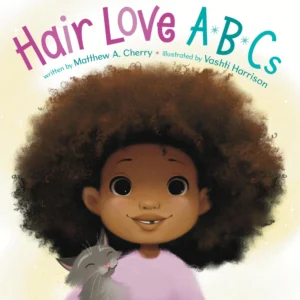
A great book to read with kiddos who struggle with the beauty of their hair is Hair Love ABC’s by Cherry Matthew, A. Harrison, Vashti, Cool Cuts by Mechal Renee Roe, I am Enough Grace Byers are a few. Whichever you find by googling “ Books for Black hair love for children” and read it early and often. Same goes for skin: start the self-love affirmations early, too.


Hair Love ABC’s by Cherry A. Matthew

Cheers to summer. Cheers to shiny, moisturized baby smiles, to well-oiled curls and ponytails jumping for joy. Parents, you’re doing great. Go enjoy the sunshine.

Free and Proud — Do You Know the Story?

It’s June, and that means the end of the school year, summer camps, and pool days with your little ones are in full swing. In previous blogs, I talked about skin care and hair maintenance for exactly these moments, however since June only comes once a year, I want to talk about two of its most significant occasions: Pride Month and Juneteenth.

This is an extraordinary month to celebrate inclusion, and I want to make sure you have the knowledge and language to educate those around you who may not. Your children will see you as a trusted ally for years to come, and you will feel more grounded and confident in your ability to understand what it means, and what it costs, to exist as a Black person in the United States.

By now, most people know that the first public Pride marches were held in the summer of 1970 — with Chicago actually leading the way on June 27th, one day before New York’s now-iconic Christopher Street Liberation Day March on June 28th. Both were held as the one-year anniversary of the Stonewall Uprising, a revolutionary act of resistance that lasted six days. If this is unfamiliar to you, I strongly encourage you to read about it. Two of its most prominent leaders were Marsha P. Johnson, a Black woman who described herself as a drag queen and transvestite, used she/her pronouns, and whose middle initial stood for “Pay it no mind,” her lifelong response to anyone who questioned her identity, and Sylvia Rivera, a Latine (the gender-neutral form preferred in many Latin American and Hispanic communities) woman who also described herself as a transvestite and is recognized today as a transgender pioneer. It is worth noting that the word “transgender” was not yet in common use during either of their lifetimes; they named and claimed their own identities on their own terms, which is itself a form of the freedom they were fighting for. Together, they founded STAR House: Street Transvestite Action Revolutionaries, a shelter for LGBTQ+ youth experiencing homelessness, with a deliberate focus on youth of color.

As we move through a month full of rainbow flags and celebration, we must also be intentional about what this history demands of us: Black and Latine queer people are still too often left behind, even within the very movements they helped build. When we talk about inclusion and equity, we must start with the Black experience — not only because Black Americans, across every community and identity, remain the most systemically denied group in this country, but because it was a Black woman and a Latine woman who first stood up and demanded the right to live out loud for a population that society had long misunderstood and cast aside. That is not a footnote, that is the foundation.

Juneteenth is both similar to Pride and entirely its own. That tension is worth sitting with. Black life in America exists in paradox: between both/and, never either/or. Both Pride and Juneteenth share a history of celebration born in the shadow of real and threatened violence, kept alive in private by communities who knew that joy itself was an act of resistance. That throughline matters. It is the same refusal to disappear.

Juneteenth takes its name from June 19th, 1865, when Union Army soldiers arrived in Texas to announce that more than 250,000 enslaved people were free by executive order. The painful truth is that the order had been given two and a half years earlier. The people of Texas were not told they were free until much later, and were never compensated for that stolen time. While many sources cite Galveston as the origin of the celebration, historians point to smaller, rural communities in counties like Brazoria as the true birthplace. Juneteenth was celebrated privately, quietly, and often in secret, out of very real fear of violence from those who resented Black freedom. A few of the very first celebrations were started by a small group of freed men, one of those people are very dear to our family. My children’s great great great Grandfather Charles Brown.

As freedom always does, it grew. The celebration expanded from Galveston to Houston and across the state. Even so, Texas itself didn’t recognize Juneteenth as a state holiday until 1980. It didn’t begin to reach audiences outside Texas in any meaningful way until the early 2000s, and as recently as 2008, fewer than half of U.S. states officially recognized it.

This history matters deeply, for your child’s understanding of the legacy, resilience, and power of Black and Brown people who, against every conceivable odd, showed up, stood firm, and refused to disappear. These are not fairy tales. They are not ancient history. They are living, present, and urgently relevant. As the parent your child looks to first, how you hold this history; with honesty, and with pride in their revolutions is the first lesson they will carry.

There is no fear in empowerment. Knowing these stories,and sharing them,is one of the most important gifts you can give your child, whether they are surrounded by other Black children or navigating spaces where they are one of very few. These legacies are global, and they belong to your child. Keep them alive: put brown baby dolls in their hands, fill their shelves with brilliant Black poets and authors, ask their teachers whose voices are centered in the classroom. Do your own homework alongside them.

The work does not stop at your front door, and this is where many well-meaning white parents stall out. Your child will move through white spaces constantly: family reunions, school events, sports teams, neighborhood gatherings. In those spaces, they will sometimes be the only Black child in the room, and they will be watching you. They will notice whether you correct a relative who says something careless, or whether you go quiet. They will notice whether you advocate for them with their teacher or whether you accept a narrative about their behavior that you would question if it were applied to a white child. They will notice whether you treat their Blackness as something to be managed in certain company, or as something you carry with the same pride you are asking them to feel.

When a family member makes a comment rooted in ignorance, and they will, your child does not need you to start an argument. They need you to say, clearly and without performance, that you see it differently, and why. That correction, offered calmly and consistently, teaches your child two things at once: that their identity is worth defending, and that they do not have to shrink themselves to make white people comfortable. You are not just raising a child. You are raising a Black adult who will one day navigate these spaces without you.

This also means doing the internal work to recognize when your own discomfort becomes the center of a moment that should be about your child. When your child comes home hurt by something racial that happened at school, the first response cannot be your feelings about it. Their experience has to land first, be witnessed first, be validated first. Your processing comes later, in a conversation with another adult. That discipline, keeping your child’s emotional reality in the foreground, is one of the most specific and demanding forms of love this particular parenting journey asks of you.

None of this is meant to overwhelm. It is meant to orient. The same courage that Marsha P. Johnson brought to living out loud in a world that had no language for who she was, the same endurance that kept Juneteenth alive in small Texas communities for over a century — that spirit does not ask for perfection. It asks for presence, for honesty, and for the refusal to look away.

For Pride Month, start with Sylvia and Marsha Start a Revolution! by Joy Michael Ellison, illustrated by Teshika Silver. A picture book written and illustrated by queer and trans creators of color that tells the story of the very two women we discussed here, complete with a reading guide to help you keep the conversation going. For Juneteenth, read Juneteenth: A Children’s Story by Opal Lee. The grandmother of Juneteenth herself, aloud with your child, and pick up On Juneteenth by Annette Gordon-Reed for yourself. Gordon-Reed’s book is essential reading for any parent who wants to hold this history with the depth and honesty it deserves.

When you know this history yourself, you become your child’s first point of reference for pride not just Pride Month, but the quiet, daily pride of knowing who they come from, and what that lineage has survived, built, and refused to surrender.


Your Child Is Not a Zoo Animal

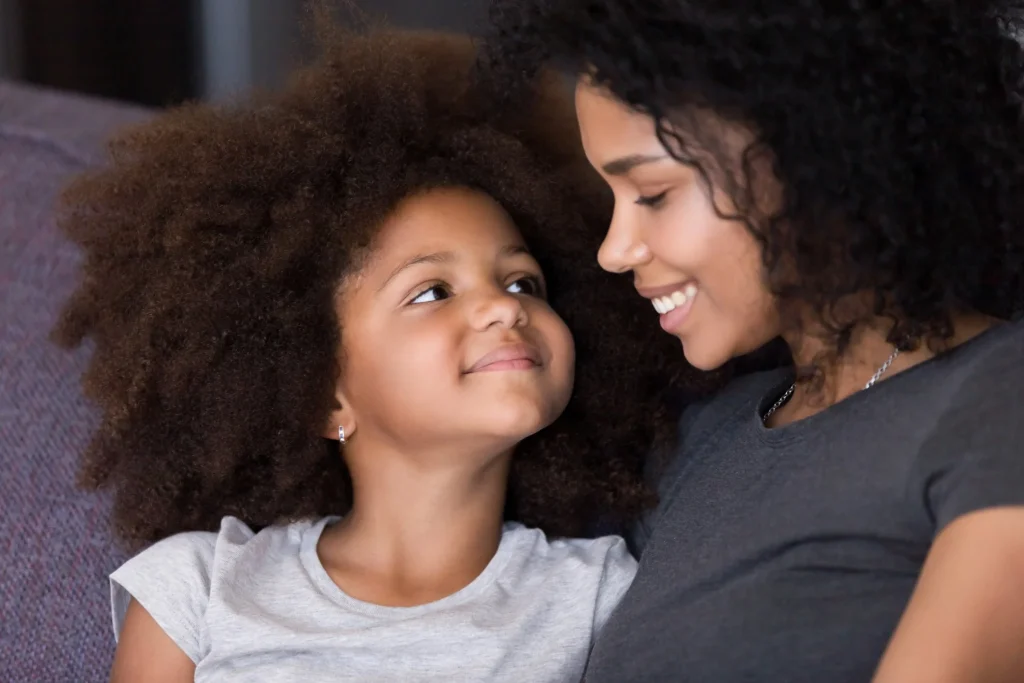
Mother and daughter sharing a close, smiling moment together

Directly, no one should ever touch your child’s hair without consent. While I’m speaking specifically about biracial children, particularly those with curly to kinky hair, the principle extends to every child. Bodily autonomy is not conditional on hair texture, race, or age. No child exists to satisfy the curiosity of another person, no matter how well-intentioned that person believes themselves to be.

Yet it happens constantly. A stranger reaches out, a relative leans in, and a well-meaning teacher, distant relative touches first and asks never. These moments are often among the first experiences of racism a biracial or Black child endures and they happen at the hands of the people who love them most. That is not a small thing, it’s a source of true identity conflict and one of the most dangerous harm is the kind dressed in warmth.

To understand why this matters so deeply, you need to understand where it comes from because this is not merely about manners. It is about centuries of dehumanization made physical.

There was a time when Black people were placed in what were called “human zoos” exhibited in Europe and the United States throughout the 19th and early 20th centuries as spectacles for white audiences. Their bodies, skin, and hair were placed on display as objects of fascination and otherness. Saartjie Baartman, known as the “Hottentot Venus,” was one of the most documented victims of this practice; paraded across Europe and studied after her death. She was not an anomaly. She was a part of a deeply disturbing pattern.

That kind of trauma does not simply end when the exhibition closes. It is carried forward in family stories, in cultural memory, in the body itself. Research in epigenetics increasingly supports what Black communities have long understood: that trauma can be inherited, encoded into the nervous system across generations. Your child does not need to have read a history book to carry this weight. They already may be coded with this trauma.

When you allow someone to reach out and touch your child’s hair uninvited or you laugh it off, or offer them up as a novel experience, you are re-enacting something much older than you realize. Your child feels it, even if they cannot name it.

People outside of Black culture are often puzzled by the significance placed on a child’s appearance particularly their hair and skin condition. Some parents, especially those who did not grow up in Black households, interpret this emphasis as vanity, or as an outdated preoccupation with looks they’d rather not pass on. I want to dismantle that assumption carefully, because the misunderstanding causes real harm.

“Presenting well” was once a phrase used to appraise enslaved Black people before they were sold. It was a term of commerce, a measure of a human being’s market value. After emancipation, Black communities reclaimed it. They transformed it into something defiant: a declaration that we take care of our own. Post-slavery Black families began to care for themselves and their children in ways that reflected their collective pride, strength, and resilience. Presentation became a reclamation, a way of saying: we know who we were before all of this, and we remember.

To “present well” became about more than looks. It became a signal of love, of belonging, of protection. When members of the Black community see a Black or biracial child who appears unkempt, particularly their hair or skin, what is activated is not judgment of the child, but grief. It reads as a severing from that thread of care and history. It is a pain that goes deeper than aesthetics.

This is not simple, It is absolutely layered, and living history.

Black hair, in all of its forms, tightly coiled, kinky, afro styled, deeply curly or dreaded, was weaponized by white colonial culture as a primary symbol of inferiority. The more “Black” your hair, the more ridicule you could expect. It was not accidental, it was codified systematically. Hair became a mechanism of racial hierarchy, used to shame, to exclude, and to rank human beings.

The Natural Hair Act, formal workplace protections, and the ongoing CROWN Act movement, legislation still not passed federally as of this writing, though adopted in many states (not all) exist precisely because Black people continue to face discrimination for wearing their hair in its natural state. Locs, afros, braids, and twists have been banned in schools and workplaces within living memory. Children have been sent home. Adults have lost jobs. For wearing their hair. Pause on that for a moment.

Wearing natural hair in America is still, for many Black people, an act that requires courage. Not because there is anything wrong with natural hair, there is not; because this country has spent centuries telling Black people otherwise, to wear hair naturally is a sometimes difficult decision of defiance. The decision to wear or not wear one’s hair naturally is deeply personal, often political, and always significant. It is not a neutral aesthetic choice the way it might be for someone outside this history.

That beauty demands respect. Not tolerance but open protection and respect.

If you are raising a Black or biracial child and you do not share their racial heritage, you have a specific responsibility. Your child’s hair is not decorative nor is it optional. It is a cultural tie, one they will one day need to understand and claim for themselves. It is one that right now communicates to the broader Black community whether or not they are in safe hands.

This is not about perfection but it is about intentionality. When you take time, care, and thought with your child’s hair, you are telling them: you are worth this effort. Your identity is worth learning. Your culture is something I honor, and hold safely.

The practical guidance is this: find a Black hair stylist who can advise you and build that relationship. For children under three, YouTube is a genuinely rich resource, there are entire communities of parents and stylists documenting this care with love. Once your child is in school, be prepared, because their hair will need regular attention and style changes, and they will begin to notice how it is treated by you, and by the world.

When you engage fully in this practice often what happens is, the time becomes warm memories. Hair days become bonding rituals. The creativity of Black hair, the braids, the protective styles, the oils and butters and the folklore of it all becomes something you share with your child, not just a task you perform for them.

Your child’s hair is an extension of their body. It is not a texture sample. It is not a conversation starter. It is not an invitation.

Curiosity is not an entitlement. “I’ve just never felt hair like this before” is not a reason. Kindness of intention does not override violation of body or that unforgettable impact. A child who is too young or too socialized to say “no” to an adult is not a child who has given consent. They are a child who has been made to comply.

When someone reaches toward your child’s head, your job is to step in before their hand arrives. Not after, don’t add a laugh and an apology on your child’s behalf. Before.

Your child is watching you. They are learning, in real time, whether their body belongs to them or to whoever finds it interesting.

They are not here for display. They are not a curiosity. They are not a zoo animal.

They are a child, and their crown is their own.

Sacred Tresses: Raising a Black Child Means Caring for Their Crown

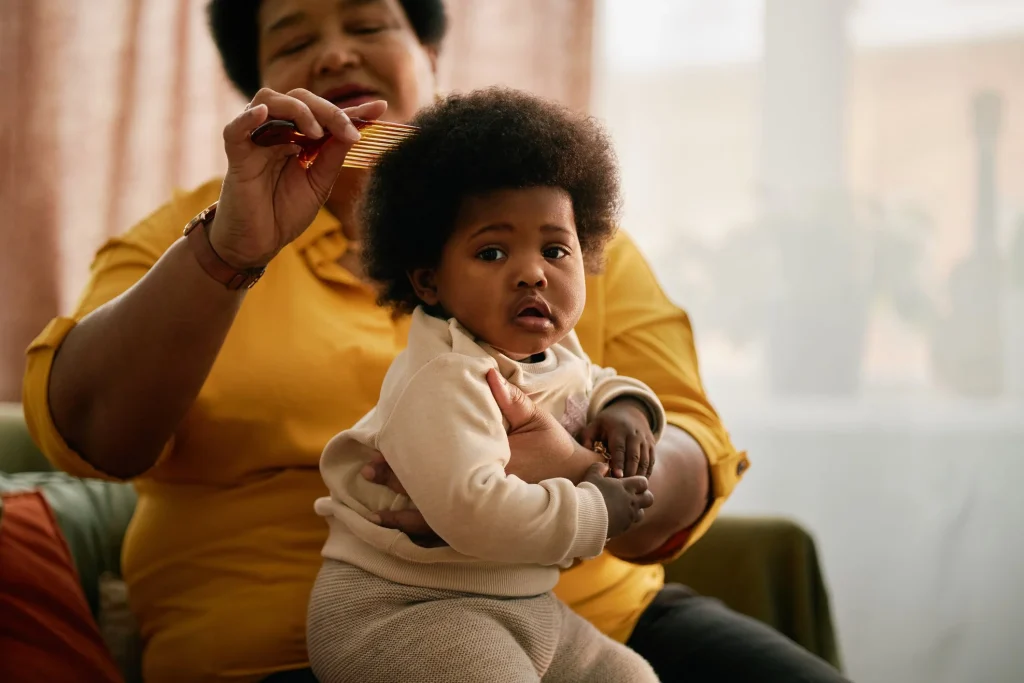
Woman carefully styling a baby's curly hair at home

Summer is here, and with it comes a question that lands in my inbox, in community groups, and in quiet, honest conversations more than almost any other: What do I do with my child’s hair?

If you are not Black and you are raising a Black child, this question is not small nor is it cosmetic. It is cultural, relational, and deeply tied to how your child will move through the world and understand themselves. I want to help you get it right not because I’m judging where you are, but because I know where this can take you both.

I want to be clear about who I am before I offer guidance. I am not a hairstylist. I am a Black woman with a formidable amount of hair. This hair I have twisted, cornrowed, and braided myself, extensions included. I have maintained a full set of locs, worn a voluminous afro, and had relaxed hair. I have two daughters, 8 nieces, 1 grand daughter and at least a few cousins, whom I have been an active, trusted presence in the care of all of their hair. I offer this not to impress but to establish: this isn’t theory. This is lived knowledge.

In Black culture, hair is not simply an aesthetic choice. It is a ritual, a legacy, and a living symbol of identity. The condition of a Black child’s hair communicates something to the world, and to the child, about whether they are seen, loved, and cared for.

I have heard too many stories of White families with Black children being approached sometimes harshly, sometimes directly with the comment: do your child’s hair. I understand the defensiveness that follows. I understand the embarrassment. I also understand why those reactions happen and what they’re pointing to.

This guide is not about shame. It is about equipping you with what you need, because the goal isn’t perfect hair, it’s a child who grows up knowing their crown is worthy of attention, care, and pride.

One of the most important things I can tell you has nothing to do with products or technique. It has to do with habit. Introduce hair manipulation early. A daily or near-daily routine even just a gentle brush, a little moisture, a few minutes of intentional contact teaches your child, from infancy, that having their hair touched is normal, expected and safe. This is what I mean when I say training, and I know that word can feel strange to parents who don’t come from a hair-ritual tradition. Stick with me here.

A toddler who has never had a consistent hair routine will resist it, they all do initially, and rightfully so, it feels foreign to them. A child who has grown up with it will sit still, will know what to expect, and will eventually take pride in it themselves. You are not just detangling hair. You are building trust, routine, and the earliest foundations of self-care.

Start gentle manipulation around six months, soft brushing, directing their hair. Whenever there is enough hair to work with you can start with loose little braids in small sections. You are not going for a perfect style. You are going for familiarity.

Washing daily is not necessary for most Black hair and in fact, over-washing can strip essential moisture. That said, life with babies means food, milk, and mystery substances end up everywhere, so use your judgment and wash as needed. Sometimes just a warm water rinse will work in that instance. What matters more than frequency is that washing is part of a predictable routine. When it does happen, make it gentle and intentional.

On moisture: Before you style, always wet the hair. A simple spray bottle with warm water and a leave-in conditioner mixed together is ideal for young children — it avoids unnecessary chemicals while providing the slip needed to detangle. Get the hair genuinely wet. Avoid gels, use natural oils instead.

On detangling: Always brush from the bottom up. Start at the ends and work your way toward the roots. Take your time. Do not rush. Do not pull.

On tension: This cannot be said strongly enough never pull tight. Not for a ponytail, not for braids, not for any style. High tension causes real damage to your child’s scalp and hair follicles and hairline, and it is never worth it. Messy buns, cared for “naturals” (afros), loose braids, and soft styles are completely appropriate, and beautiful, especially while the hair is still establishing itself. When you are beginning to practice braiding, try working without a rubber band to anchor the sections. Focus on learning the form and the parting pattern first. Clean, purposeful, and gentle is always the goal. You can anchor later, but still avoid pulling.

For tutorials on braiding, parting, and adding adornments like beads, YouTube is genuinely one of the best resources available. There is an entire community of people who have documented this knowledge generously, I’d definitely use it.

Yes and no. Curl pattern matters for styling decisions and for understanding how much tension or manipulation a style can handle. Tighter coils that tangle easily will need more moisture and more careful detangling; the spray bottle method above is especially important here.

What matters even more than curl pattern is hair porosity — how well your child’s hair absorbs and retains moisture. If you can access a specialist in Black hair, ask about this. The difference between a light oil and a heavy oil, and knowing which one suits your child’s hair, is more meaningful than most people realize. Side note: Moisture is equally important for short cuts (fades) as well.

I hear this often from parents who are not Black: that they are letting their child’s hair grow “free form.” I want to sit with this for a moment, because it deserves a careful and honest response. A free form choice — intentionally cultivating natural, unmanipulated growth — is a valid and beautiful hair journey. I know this personally. My afro is healthy, voluminous, and deeply cared for. The key word is cared for.

Free form is not the same as untouched. It requires its own moisture routine, its own attention, its own relationship with the hair. And more importantly: it is a choice that should belong to the person whose hair it is. A young child cannot make an informed choice about their hair identity. What they need, in the meantime, is to have their hair tended to with consistency and love so that when they are old enough to make that choice themselves, they have a foundation of care rather than a history of neglect.

If your child resists having their hair touched, that is information about the routine, not a sign to abandon it. All kiddos cry being held in place. It’s not always about them getting their hair brushed more than it is having to sit still to do it. Meet them with patience, shorter sessions, and gentleness. Resistance is normal. It does not mean stop.

Finding a Black hairstylist in Eugene, or the PNW more broadly, is genuinely difficult and I want to acknowledge that without letting it become an excuse. I know personally that there are non-Black stylists in Eugene who are highly qualified and experienced with Black hair textures. A knowledgeable, attentive stylist who respects the hair and culture tied to it is far better than the nearest available appointment with someone who does not.

For the deeper cultural connection that Black hair care carries, the community, the conversation, the connection, a Black stylist, if you can access one, offers something irreplaceable. A Black therapist, Black teachers, Black mentors: these relationships matter to your child’s sense of belonging and self. Do what you can with what you have, and keep looking for what works best.

Everything I have said about consistency and intentionality in hair care applies directly to skin care. This is a daily practice, and it is not optional.

Lotion and I mean real, substantive lotion after every bath, after every swim, morning and evening. The thicker the formula, the better. Look for shea butter in the first three ingredients. It is deeply nourishing for melanated skin and has been a cornerstone of Black skin care for generations.

Yes, sunscreen. Every summer, every day of real sun exposure no matter how deeply melanated your child is. Darker skin tones can and do sustain UV damage. This is not up for debate.

In winter, the routine intensifies rather than relaxes. Cold air and indoor heat are relentless in stripping moisture from skin. Keep the lotion routine consistent year-round.

The “moisturized” look — that glow, that richness, that visible vitality is more than aesthetics. It is a cultural signal that says: this child is loved and tended to. It is a grounding piece of Black identity and self-regard that your child will absorb and carry forward. Build that into the routine now, while they are small, and it becomes part of who they are.

You may not get this perfect immediately. That is fine. What matters is that you are taking it seriously, that you are learning, and that your child can feel the intention behind your hands when you touch their hair and care for their skin.

Their crown is sacred. Treat it that way and let that be something they know without ever having to be told.

Have questions, want product recommendations, or looking for Eugene-area resources? Reach out — I’m happy to point you in the right direction.

Moving Beyond Fear to Empowerment

Family embracing and smiling together on the couch at home

I want to start with acknowledging that Identity development involves many factors, adoption, foster care, multiracial identity, class, disability, and more. This piece and most of my pieces focus specifically on navigating race, recognizing there may be additional layers to your family’s experience. It’s important to recognize the lens in which we navigate information.

As a parent raising Black or Brown children while you yourself are not Black or Brown, you’re navigating something that requires more than love although love is essential. What also matters is understanding this truth: the USA was designed to ensure Black and Brown people live with fear that limits their potential. When you are Black or Brown, this reality is evident from day one. The difference lies in how we, as a community approach it.

Healthy Black communities understand that constant messages suggesting inferiority are not coming from within us, and they are not relevant to our story. We teach and live empowerment, not fear. We are not afraid of being Black. Being Black is not worrisome or scary. Which I’m sure seems like a “no-brainer”, however in reality, what is worrisome is how cultural practices of white supremacy reacts to and treats Black people. Healthy Black people do not center white people’s fear.

This is the critical distinction you must grasp: Fear of the Black experience is taught through ignorance and isolation, really just knowing the Black community only through rumors, TV, music, and/or distant perspectives. If you’ve been conditioned to fear what your child is or may become, how do you raise them to be unafraid of themselves? The deep truth is you cannot teach your child to be unafraid of themselves if you haven’t examined your own relationship with Blackness.

When you have a child developing an identity the world will work to demonize, your understanding of how Black people navigate and succeed in a discriminatory world directly shapes what and how you teach them.

Ways in which Fear shows up unconsciously could look like and is not limited to:

  • Choosing hairstyles that are “easier to manage” which turn out to be less “ethnic”

  • Skipping skincare steps to avoid attention, even though your child’s skin needs shea butter

  • Asking your “talkative” toddler or “highly energetic” middle-schooler to quiet down, to be less noticeable, to fit standards designed to make them smaller

Black and Brown children are labeled “loud” or “overly energetic” instead of engaged and excited. Your job is to know the difference and protect your child’s full expression, not police it. Policing expression that looks new to you can be a total shut down of what they are naturally expressing. Proceed with curiosity and learn who they are, without any constraint.

Your babysitter, your child’s school, even your own parents may not realize they’re damaging your child’s self-esteem by treating what is normal as something needing correction. Fear can sometimes come in at this point as protection, be careful in the reason why.

The difficulty of this work is not a reason to shy away. We have all been socialized to believe people are better or worse based on skin color. You must locate where your internalized bias lies dormant, bring it into light, and deconstruct it.

Your child needs you to acknowledge Black excellence without framing it as “success despite discrimination” as if the benchmark is proving something to white supremacy. 2. Recognize Black struggle as the ability to rise above systemic harm, not as evidence of deficiency- this can be demonstrated in your narrative. 3. Teach them what is possible, not what is safe according to white comfort. 4.Discern truly safe spaces and people, not based on assimilation, but on who affirms your child’s full humanity.

You cannot shield your child from a world that will judge them by their skin. That is painful reality. But you do not have to accept the limits that world imposes. What you must do is ensure you are not unconsciously reinforcing those limits.

Here are three ways to get started:

  1. Examine what you absorbed What did you learn about Black people growing up? Where did you learn it? What narratives about Black hair, Black speech, Black expressiveness do you carry unquestioned?

  2. Build authentic relationships in Black community If you’re raising your child isolated from Black people and culture, you’re setting them up for harm. This isn’t about Tokenizing, it’s about your child needing mirrors and your needing people who can see your blind spots. Find Black-centered spaces: bookstores, cultural events, parenting groups, churches. Show up consistently, not as a spectator, get involved in a way you and your child are joining a community, and let them shine, while you support.

  3. Learn from Black parents Read books by Black authors on Black child development (not white authors writing about Black children). Understand how Black parents teach empowerment in the face of systemic harm. This isn’t about copy and paste. This is perspective. This is a check in on your lens, this is a temperature check, and an opportunity to grow.

Prepare your child to navigate harm without internalizing it. They will encounter people and systems that don’t recognize their humanity. Your job is to make sure they know deeply, without question, that the problem is not them.

By age two, your child will notice race. By age four, they’ll ask why their skin is different from yours. By age 6, they’ll encounter their first racist comment. By age twelve, they’ll be navigating how the world sees them versus who they know themselves to be. At every stage, they need you awake and honest.

This work is ongoing. It requires you to keep examining where you might unconsciously teach your child to shrink. But this is the work that love requires when raising a Black or Brown child in a world not designed for their thriving.

So ask yourself: What is one belief about Black people you absorbed without questioning?

Start there.

The Truth of Black History Month

What does Black History Month mean to you?

If you said “the shortest month,” we need to talk. If you said, “a celebration to show us about Black people,” we need to talk. Because both of those answers accept lies as truth. In 2026, as we watch the systematic dismantling of truth in education, book bans, attacks on teaching Black history, the weaponization of the word “woke” against truth-telling and collective awareness, it matters more than ever that we get this right.

The month is, of course, a celebration, but it was first a week of encouragement to celebrate Black achievement in a time when Black achievement was not widely accepted. It’s crucial that we know the truth of this month with accuracy, not with watered-down half-truths born from the unfortunate narrative that Black history is not American history.

The story begins in Chicago during the summer of 1915. Carter G. Woodson, an alumnus of the University of Chicago, traveled from Washington, D.C. to participate in a national celebration of the fiftieth anniversary of emancipation. Thousands of African Americans traveled from across the country to see exhibits highlighting the progress their people had made since the destruction of slavery. Awarded a doctorate from Harvard three years earlier, Woodson joined with a Black history display. Despite being held at the Coliseum, an overflow crowd of six to twelve thousand waited outside for their turn to view the exhibits.

Recognizing having earned his PhD from Harvard, Woodson understood what was at stake: a community’s relationship to its own excellence. Inspired by the celebration, he decided to form an organization to promote the scientific study of Black life and history. On September 9th, Woodson met at the Wabash YMCA with A. L. Jackson and three others and formed the Association for the Study of Negro Life and History (ASNLH).

He established The Journal of Negro History in 1916, hoping others would popularize the findings. As early as 1920, Woodson urged Black civic organizations to promote the achievements researchers were uncovering. He urged his Omega Psi Phi fraternity brothers to take up the work. In 1924, they created Negro History and Literature Week, renamed Negro Achievement Week. But Woodson desired greater impact. As he told Hampton Institute students, “We are going back to that beautiful history and it is going to inspire us to greater achievements.”

Black History week was for the growth and encouragement of a community to resist settling into mediocrity. It was internal cultural work, Black people creating the conditions for our own remembering, our own inspiration, our own refusal to accept less than our full humanity. In 1925, Woodson decided the Association had to shoulder the responsibility of both creating and popularizing knowledge about the Black past. He sent out a press release announcing Negro History Week in February 1926.

Woodson chose February for reasons of tradition and strategy. He selected it to encompass the birthdays of Abraham Lincoln and Frederick Douglass, the 12th and the 14th respectively. Since Lincoln’s assassination in 1865, the Black community had been celebrating the fallen President’s birthday. The narrative that Black people were given the shortest month of the year due to disrespect is simply untrue. This myth diminishes the intentional, strategic brilliance of Woodson’s choice. It replaces Black agency with Black victimhood. It erases the fact that Black people chose February, claimed it, built something powerful within it. Woodson didn’t passively accept what he was given, he strategically chose. This distinction between passive receipt and active creation is a critical difference in narrative of Black identity in the United States. I will add that it was 50 years later that this week was granted the entire month of February by President Ford.

In 2026, when accurate Black history is being banned from classrooms, when DEI initiatives are being rolled back, when the structures that allowed truth-telling are being systematically dismantled, knowing the real story of Black History Month is an act of resistance. It’s proof that we have always had to create the conditions for our own remembering. It’s proof that erasure has always been the project, and reclamation has always been our response.

When we accept watered-down stories like February was an insult rather than a strategic choice, that this month is about what was given to us rather than what we created for ourselves, as if we accept a diminished version of ourselves. That would indicate that we settled into the very mediocrity Woodson fought against.

Black History Month was not designed for white learning. It was internal cultural work that others are invited to witness but not center themselves in. It was about a community saying: we will not let our children grow up believing we have no history of brilliance, no tradition of excellence, no legacy worth celebrating. We will research it, document it, teach it, and celebrate it ourselves. As parents who are not Black, this is something to protect, to champion, to insist on.

With this celebration, make sure it is a celebration true to its nature, its story, its legacy. Share that Carter G. Woodson didn’t wait for permission. Share that Black communities organized themselves to reclaim and celebrate their own history when it was being systematically erased. Share that February was claimed with intention, not assigned as an afterthought. Share that this month was created to inspire us to resist mediocrity and reach for the pursuit of excellence is our birthright. It is a testament to the refusal to be forgotten, the insistence on being known truthfully, and the understanding that a people who know their history refuse to settle for anything less than full potential.

Teaching Our Children a Different Story

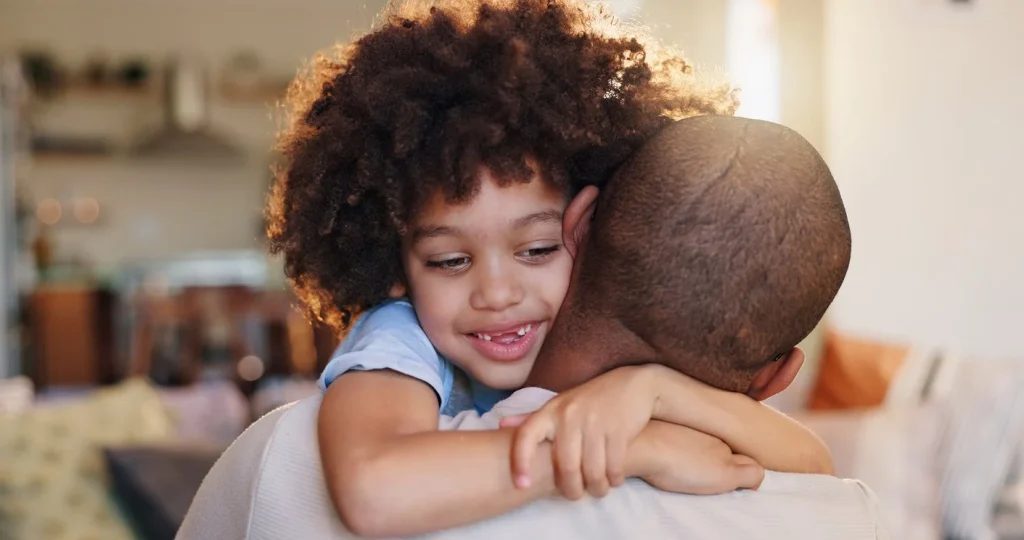
Child hugging a parent warmly at home
Welcome to 2026. I know it’s looking very complex at the moment, and I know you’re scared—we all are. I generally write these pieces for non-Black parents raising Black children; however, I think this message is for all parents of young children. This year carries a particular type of peril. Our communities haven’t faced this specific flavor of danger within the United States affecting the masses of the population since the genocide of Indigenous peoples when the invasion began 250 years ago.

That being said, our communities have a hidden code of norms that are not safe for everyone. They are norms that subtly tell some children they must wait their turn to be heard or seen, with little encouragement to dream as big as they can. The words may say one thing, but opportunity, access, and resources say something very different.

We are in a time when nothing can be taken for granted and everything good, fair, and just must be protected. We have to reach for the most ideal version of equity. This is the time to take all doubt of possibility out of your mind and insist on it, unequivocally.

This moment is slightly different from the history of marches, judicial decisions, and constitutional amendments, because this is not just about the “exceptions to the rule”, the others: people of the global majority, women, disabled folks, or the queer community. This includes people who were thought to be protected. White, educated men who are not billionaires do not get a pass. They cannot pass go. Their $200 stolen. The lie is exposed.

It is crucial to examine the narratives we have practiced and passed down. Does your narrative, your songs, your books, your baby classes actively EXPRESS inclusion? Does the park where you take the dog reflect a diverse population? Does your yoga class acknowledge and honor the origins of the practice? Are we assuming these things are by choice, or have we recognized a design of exclusion? If the answer is no, do you know why?

When we are playing with and teaching our youngest people, they are learning by example faster than AI is evolving. Language of comparison, of class, of either/or thinking is problematic in a community of inclusion. Of course, as parents, it starts with us. We have to practice this in ways that don’t insist on perfectionism, but in ways that allow for learning and practiced humility. Here are a few examples you can try:

  • Instead of “We don’t do that in our family,” try “Some families do it this way, some do it that way, and both are beautiful.”

  • Instead of “They’re different from us,” try “They do things differently than we do, what can we learn from them? What can we share in learning?”

  • Instead of “You’re so lucky to have what you have,” try “We’re grateful for what we have, and everyone deserves to have their needs met.”

  • Instead of “Those people over there,” try using names, or “our neighbors,” or “people in our community.”

  • Instead of “That’s weird or odd,” try “That’s new to me, tell me more about it.”

I believe compassion is easy for little ones. Adults tend to operate from some sort of fear. There is plenty to be afraid of, especially now, but fear will never develop into functional or positive clarity.

Children respond to joy in ways that are expansive. Children have a magic they are born with. Their minds are full of stories based only in imagination and possibility. If our stories about our neighbors, about our place in society, remove man-made barriers like race and fill their hearts with diverse language and knowledge of global humanity, then “different” only means options of possibility. Having a healthy sense of cultural appreciation, with a healthy lack of ownership, just shared joy is the world of a child’s connection.

Reject the narrative of division and insist, everywhere you are, that division is not tolerated, it is not celebrated and most importantly not ignored as a norm in this new world and your babies will follow!

The Gift of Difference

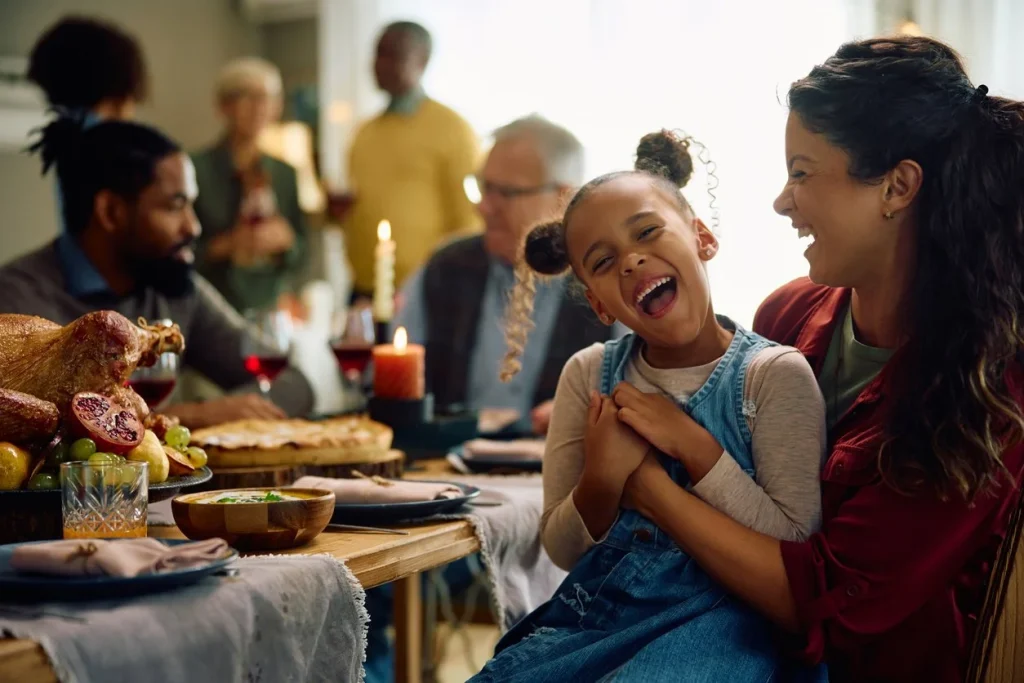
Family gathered around a holiday dinner table with a joyful child

Here we are in November, hurtling into the holiday season. For many reasons, this season brings a multitude of emotions and relationships, in its most ideal form, a sense of togetherness. Yet multiracial families raising Black children, the season can surface particular complexities. The experience of othering, of being marked as different by the outside world, is not an abstract concept but a lived reality. In our simple society, there’s a pervasive practice of assessing value based on difference: if I believe differently than you, or light my candles on a different day, somehow one must be deemed “most” important. This is unfortunate, yet easily remedied.

For white families raising children who identify as Black, it is of utmost importance to foster self-love in your child. I believe it is helpful to do so in an introduction and practice of diasporic appreciation for expression. Expression of love, togetherness, family, triumph, and loss. To be Black in this world is to be of the world. This is a pride sometimes lost in the here and now. However, I encourage you to always remember and foster in your child knowledge of a larger connectedness throughout the world. This isn’t something you must perfect yourself, but something to witness and encourage through exposure, knowledge, and a total absence of judgment about what is “good” or “better.”

Consider art, for example. True art in its purest form is simply free creation, the absence of fear. To create freely is to express without the constraint of perceived limits. If we engage only the left side of our brain and never access the right, we become stifled. Black children need to know that celebrations this season reflect diverse global stories of struggle, renewal, and joy that connect all of humanity. Whether Diwali, Hanukkah, Christmas, Eid, or Kwanzaa. Each represents a narrative of perseverance and hope. They may be religious in form, and that’s okay. You don’t have to join a religion to appreciate its story. Understanding how each narrative connects humankind; that’s the story to be told.

You don’t have to practice a tradition to appreciate what it brings to your community. The holiday season need not be reduced to only your family’s experience. Additionally, engagement doesn’t require wealth or extensive resources. It can be as simple as reading a library book about a celebration together, watching a documentary, or having a conversation with neighbors. Explaining each element of a holiday without judgment: the good, the bad, and the controversial allows your child to appreciate diversity, possibility, creativity, and storytelling. This includes difficult truths: discussing “Thanksgiving” alongside the National Day of Mourning honors the complexity of American history and teaches that honest storytelling matters more than comfortable mythology.

Your child’s critical thinking will flourish when asking questions and seeing differences as normal and expected, fostering ease and openness. Practice whatever traditions your family holds dear, of course. However, when others are celebrating, learn a little about it. If you have the means, discover where celebrations are being held to donate, contribute, or simply appreciate. Share stories with enthusiasm, respect, joy, and curiosity.

Your role is to ensure your child develops both strong individual identity and deep connection to broader humanity. We are different, and we are one. That’s the season’s lesson.

Keep Halloween Spooky, Not Harmful

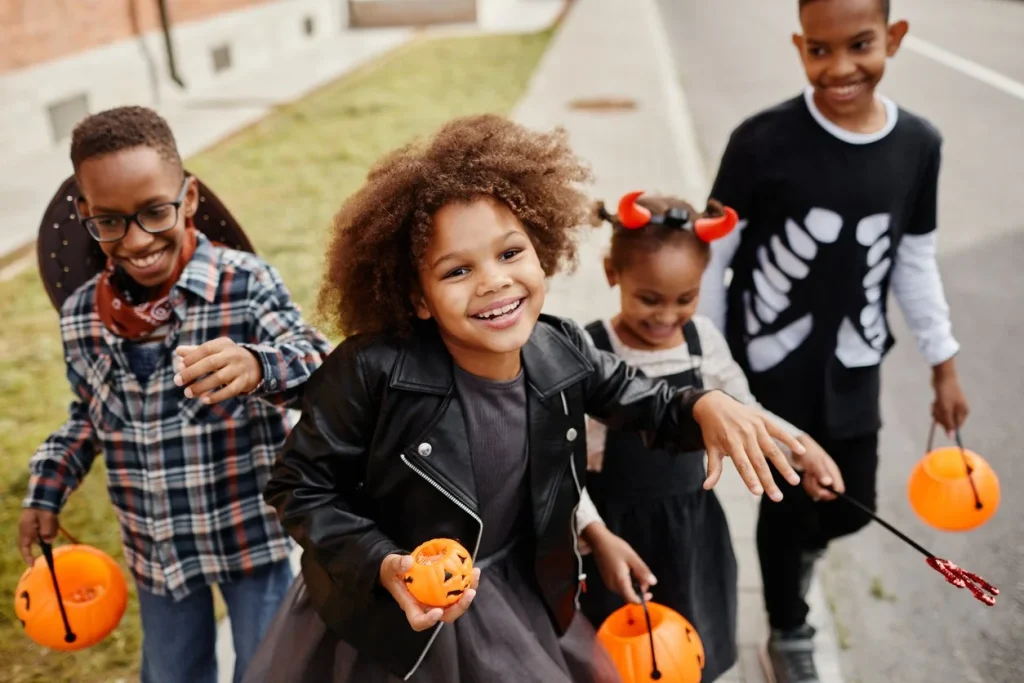
Children in Halloween costumes trick-or-treating with pumpkin buckets

If you follow my work, you know that in all of my endeavors my focus is to reduce harm. There’s no way to eliminate harm but when you know better you can certainly do better and that gesture alone can ripple into a cascade of awareness and kindness for our collective communities. During all holidays, I find this to be even more important, as during this time of year we want to focus on positive collective impact and not uniformed practices that rely on bypassing burden.

Let us remember that Halloween can be magical for children. From their first costume as babies; dressed as pumpkins with orange cheeks and tiny leaf head pieces, or as adorable kittens and witches, to their excited trick-or-treating years, in the United States this holiday centers around childhood enjoyment. I personally love to see the creativity of each person who comes to my door. If it aligns with your family’s values, there’s nothing wrong with celebrating Halloween. However, as we approach Halloween 2025, it’s crucial for all parents to understand which practices cause real harm.

In American tradition, October 31st marks when the veil between our world and the spirit world grows thin. The custom of scary decorations and costumes originally served a purpose: to blend in with wandering spirits so they wouldn’t target your home or family. Children dress as frightening creatures to disguise themselves from actual threats that are now “among us”. Keeping this in mind, may help clarify why using someone else’s identity or culture as your “shield” is inappropriate.

Lets break down some simple examples:

  1. Painting your child’s skin black or brown is never acceptable. This practice has deep historical roots in minstrelsy, which depicted Black people as unintelligent performers existing for white entertainment. No character requires darkening skin to complete a costume when done respectfully.

  2. Afros are not costumes—they’re natural hair that grows from people’s bodies worldwide. Wearing disheveled afro wigs perpetuates harmful stereotypes that cast Black hair as “unkempt,” “unprofessional,” or “wild” when worn naturally, and beautifully by Black people ourselves.

  3. Deities, religious figures, and cultural identities are not props. Hindu priests, Indian goddesses, Egyptian royalty, and historical figures like the Queen of Sheba are deeply meaningful to millions of people daily and around the world. They’re not tools to “scare away demons” or entertainment for Halloween night.

Halloween offers endless creative possibilities: zombies, witches, vampires, scarecrows, spiders, ravens, ogres, ghosts, skeletons, and countless other spooky creatures. Focus on these traditional elements rather than appropriating identities, cultures, or appearances that aren’t yours to wear for fun or entertainment. Teaching your little ones to stay within the moment

Let’s keep Halloween about children’s laughter, spooky fun, and candy bags they won’t want to share, while ensuring everyone can celebrate and we can actively reduce racial and cultural harm at the same time.