Supporting Pre-Writing Skills for Little Hands

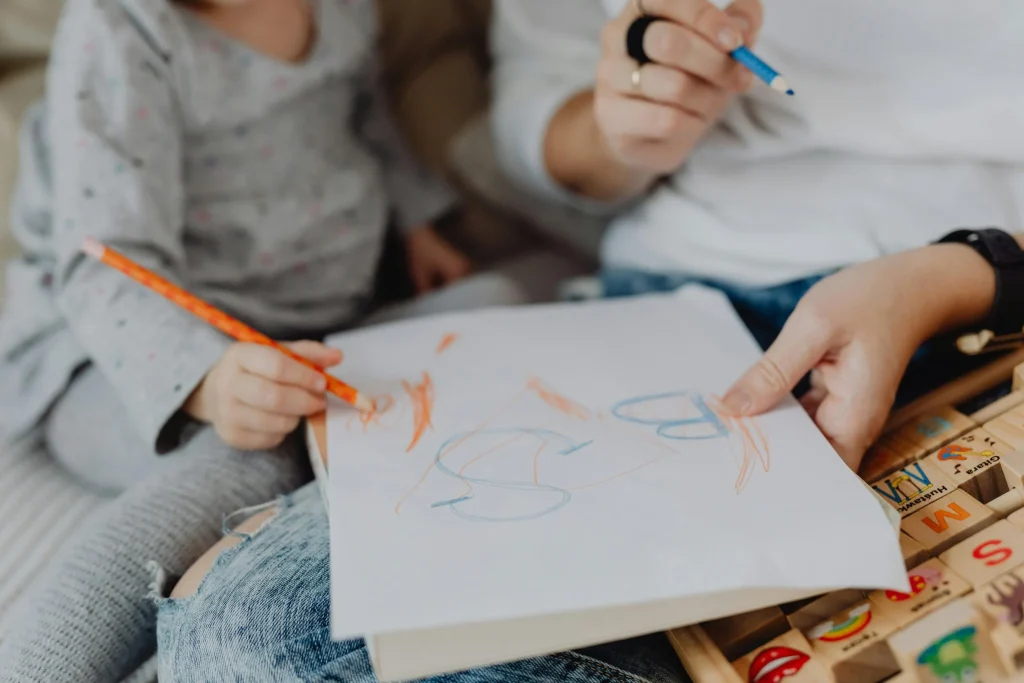
Child drawing on paper while an adult gently guides their hand

‍When I was a school-aged child, I can remember asking my mother to support me as I learned cursive writing. I wanted to learn because I loved pretty writing. As an amateur artist, I still enjoy creating artful lettering and practicing simple calligraphy with colorful inks.

What I didn’t fully appreciate as a young child was how important active play experiences would be to help me build the skills I would later need to write. There is a long progression to writing that starts with mark-making and progresses as they watch adults make purposeful shapes. Usually, we see random scribbling beginning when children are a year and a half to two years old. After that, toddlers may imitate vertical and horizontal lines and beginning circles that you show them how to draw. By preschool, children may draw lines and circles on their own and start to imitate a cross shape, squares, and diagonal lines. Around school age, young children may be able to draw a “X” shapes and triangles. From there, they will likely be able to form letters and show a preference for writing with their left or right hand. ‍

Each of these steps stem from skills that are built earlier in life. For very young children, pre-writing skills can include strengthening their hands, building the upper body strength to sit upright, learning to reach across their body, and developing good hand-eye coordination. ‍

Here are five ways to support pre-writing at home: ‍

1. Build Fine Motor Skills and Hand Strength. Pre-writing skills require strong finger and hand muscles, as well as hand-eye coordination.

  • Kneading, rolling, and squeezing play dough and clay strengthens fingers and wrists.‍ ‍

  • Have children use tweezers, tongs, or clothespins to move items like cotton balls or beads.

  • Use beads, pasta, or cereal to practice hand-eye coordination and fine motor control through threading or lacing. ‍

  • Encourage cutting out shapes or pictures with scissors from magazines, which improves hand strength and coordination.

2. Provide Posture and Tool Support. Make sure that children can sit upright with stability, and use the writing implements they are given properly.‍ ‍

  • Ensure your child has a stable, comfortable chair where their feet can touch the floor, with their back straight.

  • Using smaller, broken crayons forces children to use a proper “tripod” grip with their fingers rather than their whole hand.

  • Tape paper to the wall or use an easel/chalkboard. Writing on a vertical surface strengthens shoulders and wrists.

3. Promote Mark-Making and Drawing. Encourage early “writing,” which often starts as scribbling and drawing. 

  • Let children draw in sand, shaving cream, salt, or flour trays to practice making lines and shapes during sensory play.

  • Allow children to “paint” fences with water or draw with sidewalk chalk, which builds muscle memory for writing letters.

  • Provide thick markers, chunky crayons, and colored pencils to encourage different grips and mark-making.

  • Use tracing workbooks, dot-to-dot activities, or trace over shapes made with glue to develop control.

4. Encourage Early Letter Recognition. Adults can support children to recognize the alphabet and start to practice making letters.

  • Focus on helping them learn to write the letters in their own name. Start with the first letter of their name and have them find it in their environment.

  • Encourage making letters out of playdough, pipe cleaners, or tracing them in sand for a multisensory experience, and then reading them back.

  • Use alphabet magnets, games, or point out letters in the environment to make learning letters and other shapes fun.

  • Label objects around the house to increase letter recognition.

5. Encourage Daily “Writing” and Literacy. Show children that writing has a purpose and is used in everyday life.

  • Create an “Office” by setting up a dedicated space with paper, envelopes, notebooks, and writing utensils.‍ ‍

  • Have children help write shopping lists, fill out forms, or write birthday cards. ‍

  • Buy a special notebook for your child to draw or “write” in daily.

  • Invite your child to dictate stories, which you can write down to help them understand the connection between speech and writing.

At a time when many of us adults type on the computer or use screens for daily tasks, try to show children examples of when physical writing has been helpful in your life, such as journaling, making a to-do list, or leaving a message for a family member. Make sure and write in front of them. When your child watches you write and has access to their own writing and art materials, they will feel encouraged to practice writing, too.

‍If you have any concerns about the development of your child, there are resources to support your family. For children in Lane County, Early Childhood CARES or Connect the Dots may be able to help with early intervention and pediatric therapy. Kid Sense offers a lot of great information in their Writing Readiness (Pre-Writing Skills) webpage that covers pre-writing skills by age, potential challenges, and when to seek support from a local occupational therapist or health care provider.

‍ Resources:

‍ Here are more fun ideas for supporting pre-writing skills:

28 Pre-Writing Activities for Preschoolers

7 Fun Pre-Writing Activities for Preschoolers ‍

Preschool Pre-Writing Skills

5 Creative Activities That Help Develop Pre-Writing Skills

Moving Beyond Fear to Empowerment

Family embracing and smiling together on the couch at home

I want to start with acknowledging that Identity development involves many factors, adoption, foster care, multiracial identity, class, disability, and more. This piece and most of my pieces focus specifically on navigating race, recognizing there may be additional layers to your family’s experience. It’s important to recognize the lens in which we navigate information.

As a parent raising Black or Brown children while you yourself are not Black or Brown, you’re navigating something that requires more than love although love is essential. What also matters is understanding this truth: the USA was designed to ensure Black and Brown people live with fear that limits their potential. When you are Black or Brown, this reality is evident from day one. The difference lies in how we, as a community approach it.

Healthy Black communities understand that constant messages suggesting inferiority are not coming from within us, and they are not relevant to our story. We teach and live empowerment, not fear. We are not afraid of being Black. Being Black is not worrisome or scary. Which I’m sure seems like a “no-brainer”, however in reality, what is worrisome is how cultural practices of white supremacy reacts to and treats Black people. Healthy Black people do not center white people’s fear.

This is the critical distinction you must grasp: Fear of the Black experience is taught through ignorance and isolation, really just knowing the Black community only through rumors, TV, music, and/or distant perspectives. If you’ve been conditioned to fear what your child is or may become, how do you raise them to be unafraid of themselves? The deep truth is you cannot teach your child to be unafraid of themselves if you haven’t examined your own relationship with Blackness.

When you have a child developing an identity the world will work to demonize, your understanding of how Black people navigate and succeed in a discriminatory world directly shapes what and how you teach them.

Ways in which Fear shows up unconsciously could look like and is not limited to:

  • Choosing hairstyles that are “easier to manage” which turn out to be less “ethnic”

  • Skipping skincare steps to avoid attention, even though your child’s skin needs shea butter

  • Asking your “talkative” toddler or “highly energetic” middle-schooler to quiet down, to be less noticeable, to fit standards designed to make them smaller

Black and Brown children are labeled “loud” or “overly energetic” instead of engaged and excited. Your job is to know the difference and protect your child’s full expression, not police it. Policing expression that looks new to you can be a total shut down of what they are naturally expressing. Proceed with curiosity and learn who they are, without any constraint.

Your babysitter, your child’s school, even your own parents may not realize they’re damaging your child’s self-esteem by treating what is normal as something needing correction. Fear can sometimes come in at this point as protection, be careful in the reason why.

The difficulty of this work is not a reason to shy away. We have all been socialized to believe people are better or worse based on skin color. You must locate where your internalized bias lies dormant, bring it into light, and deconstruct it.

Your child needs you to acknowledge Black excellence without framing it as “success despite discrimination” as if the benchmark is proving something to white supremacy. 2. Recognize Black struggle as the ability to rise above systemic harm, not as evidence of deficiency- this can be demonstrated in your narrative. 3. Teach them what is possible, not what is safe according to white comfort. 4.Discern truly safe spaces and people, not based on assimilation, but on who affirms your child’s full humanity.

You cannot shield your child from a world that will judge them by their skin. That is painful reality. But you do not have to accept the limits that world imposes. What you must do is ensure you are not unconsciously reinforcing those limits.

Here are three ways to get started:

  1. Examine what you absorbed What did you learn about Black people growing up? Where did you learn it? What narratives about Black hair, Black speech, Black expressiveness do you carry unquestioned?

  2. Build authentic relationships in Black community If you’re raising your child isolated from Black people and culture, you’re setting them up for harm. This isn’t about Tokenizing, it’s about your child needing mirrors and your needing people who can see your blind spots. Find Black-centered spaces: bookstores, cultural events, parenting groups, churches. Show up consistently, not as a spectator, get involved in a way you and your child are joining a community, and let them shine, while you support.

  3. Learn from Black parents Read books by Black authors on Black child development (not white authors writing about Black children). Understand how Black parents teach empowerment in the face of systemic harm. This isn’t about copy and paste. This is perspective. This is a check in on your lens, this is a temperature check, and an opportunity to grow.

Prepare your child to navigate harm without internalizing it. They will encounter people and systems that don’t recognize their humanity. Your job is to make sure they know deeply, without question, that the problem is not them.

By age two, your child will notice race. By age four, they’ll ask why their skin is different from yours. By age 6, they’ll encounter their first racist comment. By age twelve, they’ll be navigating how the world sees them versus who they know themselves to be. At every stage, they need you awake and honest.

This work is ongoing. It requires you to keep examining where you might unconsciously teach your child to shrink. But this is the work that love requires when raising a Black or Brown child in a world not designed for their thriving.

So ask yourself: What is one belief about Black people you absorbed without questioning?

Start there.

Happy Parents, Happy Kids!

Two smiling parents with their daughter posing together indoors

Happy Parents, Happy Kids!

Having young children can be a joyous time for families, but it can also be a stressful time for the adult caregivers. Too much stress on a relationship can create discord and disconnection at a time when collaborating and supporting each other matters most.

Children learn a lot about relationship dynamics from their families. Modeling good communication, problem-solving and conflict resolution each day impacts your child’s well-being and often sets them up for their own future relationships.

In particular, children can benefit from positive co-parenting efforts that offer consistency and predictability whether couples remain together or experience a separation. Children cope more effectively when they understand what is happening and when information is shared on a developmentally appropriate level, particularly if there is a change in family structure.

Remember that love takes many forms, whether it’s the way we demonstrate our love for others or experience it when it is sown to us. Commonly, we summarize these different forms of love using the framework of the five Love Languages.

The five love languages are:

  • Acts of service,

  • Receiving gifts,

  • Quality time,

  • Words of affirmation,

  • Physical touch.

Although many of us enjoy any number of these languages, many people have a preferred way they like to experience love. Some people like to have their partner help them around the house, running arrands, or other acts of service. Others may especially value quality time together – lots of time spent hanging out our actively participating in activities together – or the poets among us may reach for words of affirmation. Knowing about each other’s Love Language in a partnership can help strengthen the bond between you.

Date nights are designated opportunities for partners to spend time together apart from the children. These can be a dinner out, visiting a winery, taking a walk or stargazing, signing up for a class together, or setting up a game night. Whether playful or romantic, investing in a strong connection and spending time together is the key.

Often, those of us in partnerships may use different love languages. However love is demonstrated in your home, it’s important to show appreciate. Appreciating your partner involves intentionally recognizing and valuing your partner’s efforts, which often leads to increased trust, deeper emotional connection, and improved collaboration. A simple thank you or making more of a gesture that demonstrates gratitude goes a long way. Showing appreciation is good for you, good for your partner, and a great thing to model for your children, who are often looking to you for signs of how healthy relationships work.

It’s not just about partnerships. Self-love and self-compassion are important for parents, too. Practicing self-love and compassion involves treating yourself with the same kindness, understanding, and care you would offer a child or dear friend. Key practices include being mindful of your emotions, embracing your imperfections (we all have them!), celebrating small wins or accomplishments, setting healthy boundaries, using positive self-talk, or cultivating self-care habits like journaling, enjoying a cup of tea, or walking outside. If the tradition of enjoying bouquets of cut flowers, lighting candles, or eating yummy chocolates appeals to you, these are things that you can give yourself all year round. 

They say that happiness is an inside job. Not only does self-love contribute to personal well-being, but it also makes us better equipped to be in healthy and happy relationships with others.

The Truth of Black History Month

What does Black History Month mean to you?

If you said “the shortest month,” we need to talk. If you said, “a celebration to show us about Black people,” we need to talk. Because both of those answers accept lies as truth. In 2026, as we watch the systematic dismantling of truth in education, book bans, attacks on teaching Black history, the weaponization of the word “woke” against truth-telling and collective awareness, it matters more than ever that we get this right.

The month is, of course, a celebration, but it was first a week of encouragement to celebrate Black achievement in a time when Black achievement was not widely accepted. It’s crucial that we know the truth of this month with accuracy, not with watered-down half-truths born from the unfortunate narrative that Black history is not American history.

The story begins in Chicago during the summer of 1915. Carter G. Woodson, an alumnus of the University of Chicago, traveled from Washington, D.C. to participate in a national celebration of the fiftieth anniversary of emancipation. Thousands of African Americans traveled from across the country to see exhibits highlighting the progress their people had made since the destruction of slavery. Awarded a doctorate from Harvard three years earlier, Woodson joined with a Black history display. Despite being held at the Coliseum, an overflow crowd of six to twelve thousand waited outside for their turn to view the exhibits.

Recognizing having earned his PhD from Harvard, Woodson understood what was at stake: a community’s relationship to its own excellence. Inspired by the celebration, he decided to form an organization to promote the scientific study of Black life and history. On September 9th, Woodson met at the Wabash YMCA with A. L. Jackson and three others and formed the Association for the Study of Negro Life and History (ASNLH).

He established The Journal of Negro History in 1916, hoping others would popularize the findings. As early as 1920, Woodson urged Black civic organizations to promote the achievements researchers were uncovering. He urged his Omega Psi Phi fraternity brothers to take up the work. In 1924, they created Negro History and Literature Week, renamed Negro Achievement Week. But Woodson desired greater impact. As he told Hampton Institute students, “We are going back to that beautiful history and it is going to inspire us to greater achievements.”

Black History week was for the growth and encouragement of a community to resist settling into mediocrity. It was internal cultural work, Black people creating the conditions for our own remembering, our own inspiration, our own refusal to accept less than our full humanity. In 1925, Woodson decided the Association had to shoulder the responsibility of both creating and popularizing knowledge about the Black past. He sent out a press release announcing Negro History Week in February 1926.

Woodson chose February for reasons of tradition and strategy. He selected it to encompass the birthdays of Abraham Lincoln and Frederick Douglass, the 12th and the 14th respectively. Since Lincoln’s assassination in 1865, the Black community had been celebrating the fallen President’s birthday. The narrative that Black people were given the shortest month of the year due to disrespect is simply untrue. This myth diminishes the intentional, strategic brilliance of Woodson’s choice. It replaces Black agency with Black victimhood. It erases the fact that Black people chose February, claimed it, built something powerful within it. Woodson didn’t passively accept what he was given, he strategically chose. This distinction between passive receipt and active creation is a critical difference in narrative of Black identity in the United States. I will add that it was 50 years later that this week was granted the entire month of February by President Ford.

In 2026, when accurate Black history is being banned from classrooms, when DEI initiatives are being rolled back, when the structures that allowed truth-telling are being systematically dismantled, knowing the real story of Black History Month is an act of resistance. It’s proof that we have always had to create the conditions for our own remembering. It’s proof that erasure has always been the project, and reclamation has always been our response.

When we accept watered-down stories like February was an insult rather than a strategic choice, that this month is about what was given to us rather than what we created for ourselves, as if we accept a diminished version of ourselves. That would indicate that we settled into the very mediocrity Woodson fought against.

Black History Month was not designed for white learning. It was internal cultural work that others are invited to witness but not center themselves in. It was about a community saying: we will not let our children grow up believing we have no history of brilliance, no tradition of excellence, no legacy worth celebrating. We will research it, document it, teach it, and celebrate it ourselves. As parents who are not Black, this is something to protect, to champion, to insist on.

With this celebration, make sure it is a celebration true to its nature, its story, its legacy. Share that Carter G. Woodson didn’t wait for permission. Share that Black communities organized themselves to reclaim and celebrate their own history when it was being systematically erased. Share that February was claimed with intention, not assigned as an afterthought. Share that this month was created to inspire us to resist mediocrity and reach for the pursuit of excellence is our birthright. It is a testament to the refusal to be forgotten, the insistence on being known truthfully, and the understanding that a people who know their history refuse to settle for anything less than full potential.

Tools to Calm Down During Uncertain Times

Person wrapped in a blanket holding a warm mug on the couch

In these complex times, caring for ourselves, our families, and our communities can feel especially demanding. It’s okay to need extra care and flexibility as parents right now.

Most of us feel a certain level of discomfort when there is a lot of change or upheaval in our lives. Adults may or may not realize how much their emotional responses can impact others around them, particularly their children.  When things are unpredictable, it’s important that we have ways to calm down and rebalance ourselves – This helps us feel better and has a positive impact on our children.

Below are recommendations that may help you as a parent manage uncertainty during stressful times like these.

Address Foundational Needs

Taking care of ourselves physically and emotionally makes a big impact on our well-being. That’s why it’s important to keep a handle on the basics: Prioritize rest and sleep routines for the entire family. Eat healthy meals and snacks and stay hydrated. Engage in physical activity and movement, even in short bursts. Set boundaries and learn to say “no” to extra responsibilities. Take breaks from screens and electronics, such as phones, email, social media, news, and TV. Identify what is in your control and let go of what is not.

Look for Connection and Support

Seeking social and emotional support from others can help lessen the burden and keep us feeling more connected. Spend time with friends, family, or other parents who understand you, or who you relate to. Ask for help or specific support when needed. Strengthen your partnerships or other close relationships. Reach out to members of your community — a strong network cultivates resilience and sense of safety for everyone. Consider support groups, online support, and local family resources for dealing with high levels of stress or strategies for healing trauma.

Mental and Emotional Well-Being

Taking time to reflect, feel our emotions, and recharge can make a tremendous difference when experiencing stress. Allow yourself to feel and express emotions, even tears. Mindfulness practices include deep breathing or short meditations to stay present. Acknowledge your efforts and find things to be thankful for by creating a gratitude list, which can often help people refocus their energies on what’s working or going well. Focus on your strengths and the many ways you are supporting yourself and others. Find what brings you joy, laughter, and happiness and do more of that. Make time for activities that you enjoy such as nature, reading, hobbies, music, or art.

Self-compassion can be helpful. Here’s how to ground yourself, as a person who is hurting, guided by Dr. Kristin Neff.

Supporting Our Children

These moments can shape how children experience the world around them, and paying attention to how children may be processing, wondering, or responding matters deeply.

Additional Resources

1. Here’s how to help children and families facing detention or separation, published by Healthy Children, and endorsed by The American Academy of Pediatrics.

2. Here’s how to talk to children about violence, NAEYC: Supporting Young Children after Crisis Events, & NAEYC Resources – Coping with Trauma, Stress, & Violence

3. Dr. Chandra Ghosh Ippen has produced many resources and books to support families to recover after stressful and traumatic events and can be found at Piplo Productions. Her children’s stories are available in multiple languages, including Spanish.

Teaching Our Children a Different Story

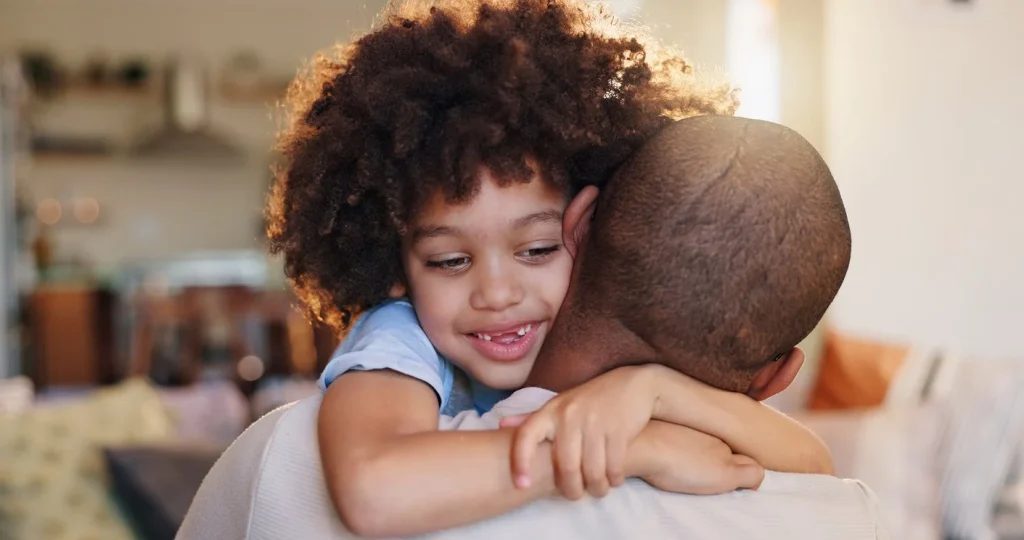
Child hugging a parent warmly at home
Welcome to 2026. I know it’s looking very complex at the moment, and I know you’re scared—we all are. I generally write these pieces for non-Black parents raising Black children; however, I think this message is for all parents of young children. This year carries a particular type of peril. Our communities haven’t faced this specific flavor of danger within the United States affecting the masses of the population since the genocide of Indigenous peoples when the invasion began 250 years ago.

That being said, our communities have a hidden code of norms that are not safe for everyone. They are norms that subtly tell some children they must wait their turn to be heard or seen, with little encouragement to dream as big as they can. The words may say one thing, but opportunity, access, and resources say something very different.

We are in a time when nothing can be taken for granted and everything good, fair, and just must be protected. We have to reach for the most ideal version of equity. This is the time to take all doubt of possibility out of your mind and insist on it, unequivocally.

This moment is slightly different from the history of marches, judicial decisions, and constitutional amendments, because this is not just about the “exceptions to the rule”, the others: people of the global majority, women, disabled folks, or the queer community. This includes people who were thought to be protected. White, educated men who are not billionaires do not get a pass. They cannot pass go. Their $200 stolen. The lie is exposed.

It is crucial to examine the narratives we have practiced and passed down. Does your narrative, your songs, your books, your baby classes actively EXPRESS inclusion? Does the park where you take the dog reflect a diverse population? Does your yoga class acknowledge and honor the origins of the practice? Are we assuming these things are by choice, or have we recognized a design of exclusion? If the answer is no, do you know why?

When we are playing with and teaching our youngest people, they are learning by example faster than AI is evolving. Language of comparison, of class, of either/or thinking is problematic in a community of inclusion. Of course, as parents, it starts with us. We have to practice this in ways that don’t insist on perfectionism, but in ways that allow for learning and practiced humility. Here are a few examples you can try:

  • Instead of “We don’t do that in our family,” try “Some families do it this way, some do it that way, and both are beautiful.”

  • Instead of “They’re different from us,” try “They do things differently than we do, what can we learn from them? What can we share in learning?”

  • Instead of “You’re so lucky to have what you have,” try “We’re grateful for what we have, and everyone deserves to have their needs met.”

  • Instead of “Those people over there,” try using names, or “our neighbors,” or “people in our community.”

  • Instead of “That’s weird or odd,” try “That’s new to me, tell me more about it.”

I believe compassion is easy for little ones. Adults tend to operate from some sort of fear. There is plenty to be afraid of, especially now, but fear will never develop into functional or positive clarity.

Children respond to joy in ways that are expansive. Children have a magic they are born with. Their minds are full of stories based only in imagination and possibility. If our stories about our neighbors, about our place in society, remove man-made barriers like race and fill their hearts with diverse language and knowledge of global humanity, then “different” only means options of possibility. Having a healthy sense of cultural appreciation, with a healthy lack of ownership, just shared joy is the world of a child’s connection.

Reject the narrative of division and insist, everywhere you are, that division is not tolerated, it is not celebrated and most importantly not ignored as a norm in this new world and your babies will follow!

For Parenting Educators: Burnout

Woman with eyes closed appearing exhausted, hand near her face

Exhausted. Nervous. Cynical. Headaches. Sad. These symptoms persisted, and I began to realize this wasn’t me. I used to feel optimistic, light, and joyful. These emotions appeared after a profoundly stressful time at work, and I didn’t like who I was becoming. Sometimes, I knew exactly why: there were WAY too many things on my to-do list, and it felt unreasonable to accomplish it all, or people I worked with were navigating significant challenges that were more than I could support. Other times, I couldn’t pinpoint why I felt all this. Maybe it was compounded stress. Labeling these feelings “burnout” helped me realize that it wasn’t a failure on my part that I was struggling. There were systems at work against me or too many responsibilities/demands on me that were unsustainable. Instead of just throwing around the term “burnout,” I could find tools to unravel these feelings instead of band-aid options.

People in caregiving positions often hold on to the stress of those they work with. If you recognize yourself as having symptoms of burnout, you might want to explore these suggestions to head toward healing. It is possible that what you are feeling is depression. Working with a therapist can help you tease out the best support for you.

Maybe it’s rigged
Sometimes, articles about self-care and burnout put the responsibility of the solution on the person navigating the feelings. Burnout might be a clue that the systems aren’t working for you. The cultural pressure to be productive so much of the time, job expectations that seem impossible, and the gender pressure many women feel to manage parenting, house upkeep, career, health, and relationships effortlessly and flawlessly are all systemic problems, not personal. We can mitigate these expectations, advocate for a healthier society, and care for ourselves. We can prioritize our needs to support ourselves. Release the idea that we are failing. Maybe the system needs to shift.

Notice and name
Slowing down to feel our feelings can help us tremendously. Identifying our feelings helps us realize that there is not something wrong with us and that there are pathways to move forward. We will not feel better if we push through and ignore our feelings. Mindfulness techniques help us pause and notice what we think. We may uncover some of the causes of our struggle. Through this awareness, we can address the root causes of our discomfort instead of trying to bubble bath it away. You may gain some clarity to help you move forward. Do you need to ask for more help with childcare? Leave a relationship? Change your job? Delegate some responsibilities? Lower your expectations for yourself?

Complete the cycle
Sisters Emily and Amelia Nagoski write about “the secret to unlocking the stress cycle” in their book Burnout. Historically, when humans faced a stressor, they often had a release after the stressful moment. If a hungry lion has spotted you, you run. Running helps you escape and helps your body process the flood of stress chemicals released by your body. Emily and Amelia suggest we don’t typically have releases in our modern stress cycles. We get a nasty email at work, mull it over, complain to a coworker, and go to the next meeting. We must “complete the cycle” and release the stress before it compounds. We can do this in many ways, but movement is an efficient answer. Hiking, dancing, jump roping, yoga, strength training, and tennis can all help release some of the stress that your body is holding. So can a good cry.

Simplify
There is much in this world that is out of our control. We can do our best to improve situations, but some things will take too long to change. We can stick to our work schedule, arriving and leaving at our set times and taking breaks. You could take a mental health day. The work will wait for you. Focusing on sleep, nutritious and convenient foods, water, and some movement can feel restorative. Can you cancel or delay some commitments to create space in your calendar?

Shanna B. Tiayan reflects on her reading of Burnout Immunity. “Burnout has a tendency to disconnect us from the things and people that are most important to us. Reconnecting with hobbies and habits that brought us joy prior to burnout, like art, gardening, or fishing, can be restorative and serve as a bridge to also reconnect with important people in our lives. Reimagine a post-burnout vision for your life, a vision motivated by optimism and hope that there is a better way forward.”

Be gentle and patient with yourself as you advocate for better conditions and prioritize your well-being.

Resources:

Burnout by Amelia Nagoski, DMA and Emily Nagoski, PhD (and a workbook)

Burnout Immunity by Kandi Wiens

Managing Secondary Traumatic Stress blog post

Slow Productivity by Cal Newport

The Gifts that Keep on Giving

Girl stacking a tower of colorful wooden blocks

I was recently at an event where a child was handed a toy. They asked an adult, “What does it do?” This was a reasonable question when there are so many toys that only seem to do one thing. And when toys only do one thing, children tend to lose interest quickly. More than anything, children require novelty for skill building.  So consider offering open-ended toys: items and materials that have nearly unlimited potential for what they can do when the opportunity arrives. In contrast to closed-ended toys, these are more versatile and allow for child-led, creative, and imaginative experiences with no predetermined rules or outcomes.

Ideas for Open-Ended Play

Building and Construction: For children who enjoy building and construction, some great options include wooden blocks, Lego, magnetic tiles or marble runs. What makes these open-ended is that they are reusable and can be configured in different lots of different ways. Keep in mind that purchasing full sets is unnecessary – the building blocks are the essential element for open-ended play. Natural materials and recyclables also make for good building supplies. Cardboard boxes, toilet paper tubes, plastic lids or twigs, stones, shells or large leaves are all excellent choices for loose parts that can be assembled or crafted into something new. It’s helpful to have designated spaces for construction and deconstruction activities.

Imagination and Dramatic Play: Open-ended play isn’t limited to construction sites. It can also come from the imagination or dramatic potential an item has. Can it be used to tell a story? Play kitchens (indoors or outdoors) and play food, dollhouses, small animals or figures, tea sets, play silks, animals, dolls, wooden bowls, spoons, pots and pans, baskets, safe containers, or other materials that can be used to extend the play experience. Role-playing outfits, accessories, and household props can bring in additional elements for dramatic play.

Art Materials and Sensory Supplies: Art supplies and sensory materials offer outlets for creative play, self-expression, and skill development. Playdough or clay and accessories, kinetic sand, paint, sensory bins, natural materials, ribbons, beads, buttons, craft sticks, yarn, paper, markers, and crayons. Keep in mind that children need encouragement to enjoy the process and explore colors, textures, and materials and not be concerned with a specific product. All they need is the space and ability to be messy and express themselves freely.

Games and Activities: Adults can also encourage games and open-ended activities that support movement and fun for children that require few if any materials. These might include Simon says, freeze dance or tag, bubble chase, animal walks, hopscotch, scavenger hunts, bean bag toss, obstacle courses, fort building with blankets and cushions, Red Light Green Light, hide and seek, or I Spy. Also, balls can be used in many ways and are often a hit with children. Feel free to draw from your own experiences and be sure to ask other adults for their ideas.

Through their open-ended play, children learn and develop many physical, emotional, and mental skills that they can build on throughout their lives. More than anything, open-ended play allows children long periods of unstructured time to get bored and shift into discovery mode, bringing forward their creativity and imagination.

Additional Resources

Check out this article by Katy Andewrson, “Loose Parts is the Real Brain Booster That Fancy Toys Pretend to Be” to learn more about the benefits of open-ended play.

This set of books on “Loose Parts” through Redleaf Press offers excellent information and beautiful photography. These can also be purchased separately at other booksellers.

For some examples of open-ended art, please read The Power of Open-Ended Art: Sparking Creativity in Preschoolers by Creative World School or The Best Kids’ Art Ideas for 2025 by Jean Van’t Hul.

Sleep and Rest Routines for the Whole Family

Young girl sleeping peacefully in bed with a stuffed bunny

We’ve all experienced the challenges of supporting an upset child who was tired or not well-rested. And we have also been in a position as parents when we tried to do more than was reasonable on less sleep than we really needed, too.

How long and how well we sleep has a big impact on the overall well-being of both children and adults alike. We need adequate sleep to:

  • Restore our energy and heal our bodies

  • Grow and develop optimally

  • Have good brain functioning that includes attention, focus, learning, decision-making and memory

  • Regulate emotions and behavior

How much sleep is enough? According to the Centers for Disease Control and Prevention, how much sleep you need depends on how old you are, and they provide guidance on the daily recommended hours of sleep for children and adults of various ages. This can range to as much as 17 hours a day for newborns, all the way down to just seven hours a day for some particularly light-sleeping adults.

Getting sleep right is important: children who are chronically tired are less able to regulate their emotions and behaviors and have difficulty paying attention. It can impact their physical, emotional and mental health. If you are concerned about your child’s sleep, talk to your healthcare provider. They will be able to look at health problems that may be getting in the way of nighttime rest requirements or support an individualized approach to address the needs of the family.

Since sleep influences our long-term health and wellness, having family bedtime routines can support quality sleep habits for everyone and improve cooperation in children.

Some steps we can take to develop these habits for our children:

  1. Encourage children to develop awareness of their body’s need for rest and calm.

  2. Set a consistent time for bedtime that takes the age of the child (see the above CDC link) into consideration. Start to reduce lights, noise, screen use, and activity in the home well before that time.

  3. Use a predictable schedule for washing up, brushing teeth, using the bathroom or diapering, and putting on night clothes.

  4. When adults provide balanced schedules and boundaries, children can practice self-regulation and change from active to restful.

  5. Children will seek connection for safety and comfort, so make time for cuddles, sharing stories, and reading books to meet their emotional needs. Read Brightly has a list of books by Jennifer Ridgeway that can help in Sleepytime Stories: Books to Help Children Build a Bedtime Routine.

  6. Create a peaceful sleep environment for children using white noise or soft music, calming scents such as lavender or chamomile, cool temperatures, and darkness (add a nightlight, if needed).

  7. Getting up at the same time each morning and having balanced daily routines that include appropriate activity and rest periods can help improve naps and nighttime sleep. Observe signs of maturation in the child as they outgrow naps and consolidate sleep.

Sometimes families will put lots of thought and care into a bedtime routine and find that their child just doesn’t want to play along. That’s why I recommend, as you’re planning a bedtime routine, try allowing your child to have some choice in their routine, such as what they wear or what special comfort items they bring to bed. This helps reduce power struggles for children, who naturally seek autonomy and independence even from young ages.

Some children can become stressed about being separated from their parents during the night, so be sure they receive care and attention in positive ways to encourage relaxation and sleep. Adults can join their children in being quiet and still as they transition to sleep or rest.

Sweet dreams families!

Understanding ADD and ADHD

Child running quickly through a wooded field wearing a helmet

We know that your love for your kid is indescribable. At the same time, we can be exasperated by their seeming constant high energy or forgetfulness. If you are parenting a child with a diagnosis of ADD or ADHD, or if you are noticing your child has symptoms, you may be wondering what you can do to support them. Understanding that their brain works differently can help you have more compassion for their experience and patience as you navigate home life together.

Understanding ADD and ADHD
Attention Deficit Disorder and Attention Deficit Hyperactivity Disorder are brain conditions that manifest in different ways but are often categorized by inattention (but sometimes hyperfocus) and difficulty controlling behavior.

People with ADD or ADHD usually feel frustrated at forgetting things, losing items, or being late. They sometimes think that life seems easier for most other people as they struggle.

Many people with ADHD are highly creative and can hyperfocus on a project they are excited about. They are often resilient and great conversationalists. Learning more about these conditions will help you support your child and help them understand how their brain works.

Parenting Tips
We want to focus on the positive with our kids so they feel we are in their corner instead of pointing out when they have missed the mark. We can help build social skills by reminding kids to listen well without interrupting and ensuring everyone has a turn to contribute to the conversation.

Building routines and organizational strategies will support our kids as they move toward adulthood. A WebMD article suggests breaking tasks into smaller steps that they can check off.

Angela Duckworth writes for Character Lab to “Notice when they plan ahead: ‘Great job getting all your stuff organized!’ Appreciate ingenuity in navigating self-control dilemmas: ‘Keeping your cell phone in a different room is such a clever idea!’

Treatment Options
We are not medical doctors, and each person is different. We encourage you to talk at length with your medical provider to find the best options for your family.

You may want to consider communicating with your child’s school so they can implement accommodations to support your student as well. Some of these are simple, such as offering immediate feedback. Others may need documentation to help, such as additional time for tests.

These supports may be crucial to have in place as your student ages and possibly attends college or university classes. Your child may qualify for a 504 plan if your student’s learning is affected.

Hold on to the unconditional love you have for your child. Surround them with that and help them break down any shame they might be feeling about this difference.

Understanding the brain better may help you build patience to greet your child with love. It is not a problem or something wrong with them. Help them see the strengths they have and the joy they bring to your family.

Resources:

ADHD is Awesome by Penn Holderness and Kim Holderness

Children and Adults with Attention-Deficit/Hyperactivity Disorder (CHADD)

Helping Kids with Behavior Struggles – An OPEC blog post

Mindful Parenting for ADHD by Dr. Mark Bertin and Ari Tuckman, PsyD

Raising Girls with ADHD by Mary Anne Richey