
Indoor Crafts For Rainy Days

The winter months can be challenging for restless toddlers. The weather has most families inside, which can make it difficult to keep your child entertained on those cold, rainy days.

If you’re feeling in a rut, here are some ideas to engage your child and have some crafty fun together!

Paper Snowflakes

Materials:

  • White paper – computer paper is the easiest

  • Scissors

Instructions:

  • Fold the paper in a simple way. Young kids can make beautiful snowflakes with a piece of paper folded into fourths.

  • With adult supervision cut the paper on the edges and in funny directions.

  • Open the paper up to see your fun and festive snowflake!

Paper Hearts

Materials:

  • Colored Paper

  • Markers or crayons if you want

  • Scissors

Instructions:

  • Fold paper in half

  • Draw half a heart shape on the piece of paper where the fold part of paper is.

  • Cut out on the line

  • Ask your children what they are thankful for and decorate your house with all the hearts.

Kool-Aid Soft Dough:

Materials:

  • 2 mixing bowls

  • 1 cup of salt

  • 1 cup of water

  • 2 cups of flour

  • 1/3 cup of oil

  • 1 package of Kool-Aid

Instructions:

  • Together with your child, measure and pour the flour and salt into the first bowl and mix.

  • Pour the oil, water and Kool-Aid into the second bowl and mix thoroughly.

  • Pour the liquid mixture into the flour mixture and mix and squish until you have soft dough.

Guest blog by Kalina Glover Moresi. Parenting Now offers parenting groups and drop-in programs for families with children 0-8, and is passionate about happy, healthy families. For more information about Parenting Now! please visit their website or contact us at info@parentingnow.org.

Triple P – Positive Parenting Program

Are you interested in receiving more parenting advice? Triple P Online – Positive Parenting Program could be for you! This online parenting program allows you to take a parenting class in the comfort of your own home!

If you live in Lane County, you can get Triple P Online for free by filling out the form on the Triple P page. A staff person from Parenting Now will send you an access code within 24 hours and you’ll be able to start using the program right away! For more information about the program and to sign up visit the Triple P page.
Winter Fun and Safety

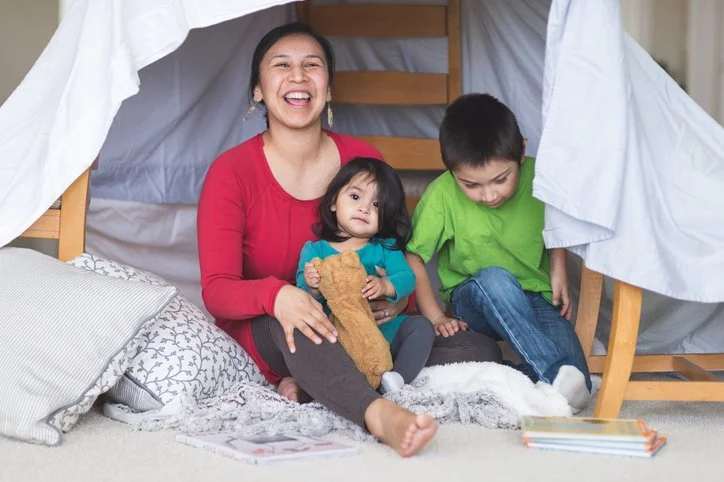
Parent and two children laughing together inside an indoor blanket fort

Rain, rain and more rain, and yet you can still enjoy all of winter with your toddler. Maybe those early winter days of sweet indoor cuddling are gone as more chilly grey days arrive, but having a variety of indoor activities to keep your child busy and stimulated will make for a happy winter for all.  You don’t need fancy or expensive toys. There are lots of fun and safe playthings you can find with everyday objects in your home:

  • Create a simple scavenger hunt. Place three red objects around the room — a red apple, a red cup and red toy fire truck. Your child will love exploring and finding the objects and will learn about colors (shapes or sizes) too.

  • Use empty egg cartons and make long trains with them. Try decorating them.

  • Make a simple bread dough (or buy some pre-made) and create interesting shaped breads to bake. Then eat your work!

  • Make music! Tambourines or shakers work, as do wooden spoons and pots.

  • Make pretend snow.

  • Build an inside fort or tent to cozy up in.

  • Use toilet paper rolls to make binoculars

Winter Safety

If your child is busy with fun activities, they are less likely to get into mischief. Of course, even if your child is occupied, it’s still critical to take general safety precautions like keeping knives, sharp objects, and medicine out of reach. There are extra winter safety issues to be aware of too:

  • Never put space heaters in a child’s room or where they are sleeping. Keep anything that can burn at least three feet away from space heaters.

  • Winter can mean more open flames in your home. Whether it’s a kerosene lamp, a fireplace, candles or other open flames, make sure they are well out of reach of children – remember toddlers are very resourceful when trying to get to something that sparkles or glows.

  • Don’t use electric blankets or heating pads with young children, and if you have an infant, use sleeping sacks or warm sleepers instead of blankets in sleeping areas.

Out and About

Even when it’s cold or rainy, it’s still a good idea to get out of the house with your little one. Sometimes just stepping out the front door is enough to change a mood. Between rainstorms, kick a ball back and forth, or encourage your toddler to throw the ball across the yard, retrieve it, and throw it again. If you really want to enjoy the outdoors with your child, Mt. Pisgah has fun, interactive stations where kids can learn about nature. Hedricks Park is a fun place to look at native flowers and trees, or just run around in the big, open grassy area. Your neighborhood park is a great place to look for worms in puddles, or watch the wind blow leaves.When you do head outdoors, be sure to:

  • Dress your child in layers. A good rule of thumb is to dress babies and young children in one more layer than an adult is wearing.

  • Make sure places on your child’s body that can get particularly cold or damp are covered — hands and feet, head and ears.

  • Don’t overdress! Children can get sweaty and overheated, causing problems like skin irritations.

  • If you are outside for an extended period, check if layers need to come off or on.

  • If it’s frightfully cold, avoid taking your child, especially infants, outside as much as possible.

  • Do not put your child in a winter coat or snowsuit while buckled in their car seat. Instead, put an extra blanket over the straps if it is especially cold outside.

  • Strings or scarves can get caught and strangle small children, so choose other warm items to wear.

  • Use sunscreen for babies over six months of age; we can still get burned on cloudy or cold days.

  • Keep them hydrated; offer warm drinks and water often. We lose moisture through our breath.

Winter doesn’t have to be filled with weariness or worry! There are lots of exciting and safe things to do indoors and outdoors and around town, too. You might even miss winter when it’s over – especially if you remember to let yourself join your child in jumping in puddles.

This article is brought to you by Parenting Now! Parenting Educators and authors Amanda Bedortha, Claire Davis and Lynne Swartz, and consultant Jay Thompson. Parenting Now offers parenting groups and drop-in programs for families with children 0-8, and is passionate about happy, healthy families. For more information about Parenting Now, please visit their website or contact us at info@parentingnow.org.

Triple P – Positive Parenting Program

Are you interested in receiving more parenting advice? Triple P Online – Positive Parenting Program could be for you! This online parenting program allows you to take a parenting class in the comfort of your own home!

If you live in Lane County, you can get Triple P Online for free by filling out the form on the Triple P page. A staff person from Parenting Now will send you an access code within 24 hours and you’ll be able to start using the program right away! For more information about the program and to sign up visit the Triple P page.

STEAM in the Kitchen

Cooking and baking alongside your toddler and young child results in so much more than just a tasty meal or snack! When we cook with our child, we provide opportunities for learning science, technology, engineering, art, and math (STEAM). STEAM is a way of looking at learning that explores many subjects within the same activity—and your kitchen is the perfect place to explore these ideas and have fun doing so! Cooking, by nature, is all about scientific reactions—the way cornstarch thickens soup, or yeast helps bread dough rise. But it can also be about making food art, or engineering the tallest sandwich tower! When you do a cooking project, ask your child to guess what they think might happen. Then observe how it turned out. Becoming a master of anything begins with curiosity, and cooking is all about experimenting with flavors, textures and colors. Measuring, pouring, stirring and watching food grow and change are all about math and science, but also spark creativity and artistry. And don’t we want learning to be fun? Here are some ideas for teaching STEAM using food:

Watermelon Volcano Experiment:

Just in time for summer, turn a watermelon rind into an exploding volcano (after you save the red, ripe delicious insides for a snack, of course)! Supplies:

  • Small watermelon

  • Baking soda

  • Vinegar

  • Dish soap

Steps: Carve your watermelon like you would a pumpkin, cutting a small hole in the top (just big enough so that you can get your hand into it. Then, scoop out the watermelon insides so the watermelon is hollow—save your watermelon for snacks later! Then, pour ½ cup baking soda into the watermelon, followed by a few drops of dish soap. The fun really begins when you pour in the vinegar and your watermelon volcano “explodes”!

Ice Cream in a Bag:

Making your own ice cream is a great way to get the whole family moving and shaking—and cool off during hot summer days. Supplies:

  • 1 tablespoon sugar

  • ½ cup Half & Half

  • ¼ teaspoon Vanilla Extract

  • ½ cup table salt

  • 4 cups of ice cubes

  • Small, sealable sandwich bags

  • Gallon-sized freezer bags

  • Oven mitts

Steps: In a small sealable bag, add 1 tablespoon of sugar, ½ cup of Half & Half, and ¼ teaspoon Vanilla Extract. Set aside. In a gallon size sealable bag, add 4 cups of ice cubes and ½ cup of salt. While still sealed shut, place your small bag of sugar and milk into the large bag of salt and ice. Seal the bag. Wearing oven mitts, shake the bags for 5 minutes. Then, the ice cream is ready to eat!

Fruit Rainbow:

Fruits and vegetables are full of beautiful colors—and taste good too! Have a fun, and yummy time with your kiddos making a fruit rainbow. Supplies:

  • Strawberries (Red)

  • Oranges or golden raspberries (Orange)

  • Pineapple (Yellow)

  • Green grapes (Green)

  • Blueberries (Blue)

  • Purple grapes (Indigo and Violet)

  • Plain yogurt

Prepare your fruit by washing it and cutting the strawberries, oranges, pineapple, and grapes into ¼ size bites. Assemble your rainbow by following the sequencing of rainbow colors “ROYGBIV”:  red, orange, yellow, green, blue, indigo and violet. At the ends of your rainbow, add a few dollops of plain yogurt for clouds. Enjoy!

Fun in the kitchen

“Some people like to paint pictures, or do gardening, or build a boat in the basement. Other people get a tremendous pleasure out of the kitchen, because cooking is just as creative and imaginative an activity as drawing, or wood carving, or music.” — Julia Child

There are so many ways to look at cooking through a STEAM lens. And whether your child is a toddler or a tween, there are lots of age-appropriate activities for using STEAM in the kitchen. Enjoying time doing a STEAM learning activity with your child builds lifelong memories and sparks their passion for learning through fun and creativity.

This article is brought to you by Parenting Now Parenting Educators and authors Amanda Bedortha, Claire Davis and Lynne Swartz, and consultant Jay Thompson. Parenting Now offers parenting groups and drop-in programs for families with children 0-8, and is passionate about happy, healthy families. For more information about Parenting Now, please visit their website or contact us at info@parentingnow.org.

Triple P – Positive Parenting Program

Are you interested in receiving more parenting advice? Triple P Online – Positive Parenting Program could be for you! This online parenting program allows you to take a parenting class in the comfort of your own home!

If you live in Lane County, you can get Triple P Online for free by filling out the form on the Triple P page. A staff person from Parenting Now will send you an access code within 24 hours and you’ll be able to start using the program right away! For more information about the program and to sign up visit the Triple P page.

Developing An Interest In Sports

Children are born movers and shakers. Starting in infancy, babies wiggle and squirm in an effort to move their bodies through space, grab onto things, and explore the world. Giving your baby lots of opportunities to manipulate and explore encourages a curiosity and mastery that lays a strong foundation for love of learning and moving. Pillow obstacle courses, tunnels, and blanket “forts” are all challenging and fun for little ones. In toddlerhood, children discover the joys of kicking or throwing a ball, or racing mom or dad down the hallway. By elementary school, kids are running around the field, climbing on playground equipment, and enjoying learning about different sports in gym class. While not all of us grow up to be the next Serena Williams or Michael Phelps, there is plenty to be gained from engaging in sporting activities of all kinds. Here are some tips for developing a love of physical activity at an early age.

Start early

Kids need encouragement and a foundation of confidence to play most sports. Start early to develop basic skills like catching and kicking balls, hopping, skipping and jumping. You can help your toddler develop these skills by:

  • Hopping on one foot, two feet, and jumping over items.

  • Making and going through obstacle courses.

  • Helping them learn to use the playground equipment at your local park safely.

  • Going for walks in your neighborhood and balance on the lines of the sidewalk like a balance beam.

  • Playing hopscotch at the park.

  • Playing catch with different kinds of objects – balls, paper airplanes, discs like Frisbee’s or balloons.

  • Rolling a ball back and forth to one another.

When your child is young, make physical activities fun and simple. Play silly games and get creative with how your child wants to play a game or sport. It’s OK if they don’t “kick” the soccer ball, but instead toss it to you. As long as your toddler or young child is moving their body, it’s OK! Games like “red light, green light” and “mother may I” help them learn impulse control and to follow simple directions as they move their body. Both of these skills are important as they learn a new game or sport. Young children also love to be praised, so keep the compliments and high fives coming as you play together. The joy of spending time moving your bodies when you play together releases those feel good hormones that improve overall mood and reduce stress for both of you. Investing time having fun together builds your relationship with your child, putting “money in the bank” for the stressful times ahead. Your child will be more likely to cooperate with you when you have built up those positive interactions.

Tips for older children

As your child gets older, you can start introducing more challenging physical activities to get the body moving, such as:

  • Hiking a nearby trail.

  • Climbing a rock wall at the playground.

  • Practicing basketball shots at the schoolyard.

  • Riding a bike.

If you think your child might be ready to learn a sport or participate on a team, ask them about the types of sports they are interested in trying. There are so many options for kids, including soccer, basketball, Tee ball, ice skating, lacrosse, swimming, martial arts, and so on. Find out what your child is interested in, watch a sporting event together, or attend a lesson to get a feel for what learning the sport is like. If you are unsure where to start, connect with KIDSPORTS, Willamalane Park and Recreation District, Eugene Family YMCA for some ideas. In addition, here are some points to consider:

  • Let your child decide the sport they want to play—rather than push your favorite sport on them. Helping kids make choices for themselves will help them become better decision makers and reduce arguments and power struggles later on.

  • It’s OK if they want to try lots of sports! Interested in soccer in the spring and softball in the summer? Let them try out their abilities in different ways.

Lead by example

One of the best ways you can encourage your child to engage in a sport or physical activity is through being active yourself. It can be hard to find time for fitness or hobbies when you are caring for little ones, so try to find activities that you can do as a family, such as walking, running, kicking a ball around the field, throwing a Frisbee back and forth. Or you could even learn a new sport together! This fun, physical play supports the whole family healthy ways to reduce stress and reset your moods. Engaging in a sport, regardless of what kind, provides all sorts of learning experiences and promotes healthful, lifelong skills. Encouraging your children to participate can be fun for the whole family!

This article is brought to you by Parenting Now Parenting Educators and authors Amanda Bedortha, Claire Davis and Lynne Swartz, and consultant Jay Thompson. Parenting Now offers parenting groups and drop-in programs for families with children 0-8, and is passionate about happy, healthy families. For more information about Parenting Now, please visit their website or contact us at info@parentingnow.org.

Triple P – Positive Parenting Program

Are you interested in receiving more parenting advice? Triple P Online – Positive Parenting Program could be for you! This online parenting program allows you to take a parenting class in the comfort of your own home!

If you live in Lane County, you can get Triple P Online for free by filling out the form on the Triple P page. A staff person from Parenting Now will send you an access code within 24 hours and you’ll be able to start using the program right away! For more information about the program and to sign up visit the Triple P page.